US, Hindutva and Zionism Equation
Indian HOLOCUST and My Father`s Life and Time- EIGHTY TWO
Palash Biswas
Salim project is cleared by centre run by Cong led UPA aligned with Left. Now RIL gets 9,000 acres at Rs 2,200 cr for Haryana SEZ. US meeting with Muslim leader invites Left ire while US Iran stand off has intensified once again the direct battle to protect US interests in Asia. In 1999 then consul general Christopher Sandrolini ignited a similar diplomatic minefield when he sent two US consulate officials to Birbhum district following the massacre of 13 farmers allegedly by CPI-M men. On the other hand in Paris France told Palestinian President Mahmoud Abbas on Saturday it would be "disposed to co-operate" with a planned government involving Abbas's Fatah and Hamas and seek support for it from other Western powers.But Abbas, ending a European tour in Paris, received no clear indications the EU would end a blockade that has caused economic hardship in the Palestinian territories. The sanctions were imposed to induce the militant Hamas group to recognise Israel, renounce violence and accept interim peace deals.
Despite Cheney warns of Iran's nuclear ambition, Iran seems not to oblige and it is well set for a repeat of Vietnam, Korea, Hiroshima, Nagasaki, Iraq and afganistan. Iran said Sunday it successfully tested a rocket that went into space, apparently part of its drive to launch five satellites into orbit by 2010.Iran’s Science and Technology and Defense ministries built the craft, state-run television quoted Mohsen Bahrami, the head of Iran’s Space Research Center, as saying.Bahrami provided no other details beyond saying that Iran had successfully launched what he called a space rocket or space missile.Psychological warfare has been a feature of Iranian-US relations since the 1979 Islamic Revolution. Both sides have made extensive use of it, not only to damage the morale of the other, but also as a way of managing the conflict and preventing it from escalating into a shooting war. But never has this psychological war been so intense and potentially dangerous as it is now.
US consul general Henry V. Jardine’s meeting with Jamait Ulema-i-Hind general secretary Siddiqullah Chowdhury has prompted political parties to take a fresh look at the organisation’s impact on the state’s Muslim population.While some argue the meeting may alienate Muslims who are hostile to Americans because of the war on Iraq, others believe it would boost Chowdhury’s image in the community.
“Siddiqullah is not just a Muslim leader but a force to reckon with. He has taken a fair amount of the anti-Left space that could have gone to the Trinamul Congress. But our vote-bank is increasing steadily because of the land movement,” said Trinamul MLA Partha Chatterjee. Chowdhury’s anti-acquisition protests had got “immense support” in Nandigram and Bhangar, where a large chunk of the population is Muslim.
According to political observers, the Jamait might see Chowdhury’s meeting with Jardine as a sign that the organisation is gaining “prominence”.
On the other hand, some parties feel the meeting might shrink Chowdhury’s political base in minority-dominated areas. “That may help the Left regain the support of Muslims who have drifted away from the CPM because of the land acquisition controversy,” said an RSP leader.
The Trinamul, however, feels otherwise. “If Siddiqullah’s base shrinks because of today’s meeting, Mamatadi will certainly be the sole gainer as she is also fighting on the same issue’’, party general secretary Madan Mitra said.
CPM central committee member Benoy Konar criticised the consul’s visit. “How can the US interfere in our state’s activities? This is an attack on our sovereignty, and they had earlier done the same in Nanoor. The matter will be discussed at our state secretariat meeting,” he said.
RIL gets 9,000 acres at Rs 2,200 cr for Haryana SEZ
Chandigarh, Feb 25: Reliance Industries has acquired 9,000 acres of land in Haryana at Rs 2,200 crore for setting up the country's largest multi-product special economic zone (SEZ), which when completed would spread over 25,000 acres.
The company, which floated a joint venture with Haryana State Industrial and Infrastructure Development Corporation for the project in June last year, paid Rs 400 crore to Haryana Government toward the portion of land acquired from it, official sources said. They said the Mukesh Ambani-led company has also identified the site for a 2,000 MW power plant that is proposed to be set up as part of the SEZ.
The power plant is expected to come up near Rohtak, the sources said, adding that a round of intense discussions was held last week between officials of the company and the state government on the power project, which could involve an investment of Rs 7,500 crore. While the money would be infused in phases, the company is understood to have initiated talks with power equipment and machinery manufacturers, including GE, Alstom, BHEL and ABB.
Former NTPC Chairman DV Kapoor is overseeing the power project.
Reliance Industries (RIL) would be investing Rs 25,000 crore, besides attract third party investments to the tune of Rs 1,00,000 crore for the SEZ project that would also house a cargo airport. The zone would be spread between Garhi Harsaru and Jhajjar. RIL hopes to develop the SEZ as a world-class hub for manufacturing, services and agro-based industries and also focus on new economy sectors like Nano-technology and biotechnology.
Reliance holds 90 per cent stake in the joint venture company, while HSIIDC the remaining stake.
The company has already developed a master plan, which envisages development of a fully integrated city having an airport, rail linkages including from Delhi Metro, an international container depot and adequate supply of power, water and communication facilities, officials said.
Singur: Farmers protest, demand return of land
February 25, 2007 14:18 IST
Buoyed by the Kolkata High Court's criticism of the West Bengal government over the acquisition of land for the Tata Motors' car plant in Singur, members of a group led by the Trinamool Congress staged a protest on Sunday outside the facility and demanded the return of the land. At least 500 members of the Save Farm Land Committee from Gopalnagar and Bajemelia villages protested outside the project site at Beraberi Purbapara and shouted slogans as a large contingent of police stood guard. The protestors said their sit-in was proof that they had not given up their land or taken the compensation given by the state government.
The demonstration came in the wake of the High Court's observation on February 23 that the state government's process for acquiring land at Singur for the project prima facie appeared to be illegal.
The court also directed it to furnish all details of the controversial acquisition of 997 acres.
The protest was planned by the Committee on Saturday.
Social activist Medha Patkar, who has criticised the 'forcible' acquisition of farmland for the small car project and was prevented from entering Singur on several occasions, is scheduled to address a rally of farmers on Monday.
This will be her first visit to Singur since prohibitory orders barring rallies and protests were withdrawn earlier this month.
The officer-in-charge of Dadpur police station, who was among the large number of policemen deployed for the past few months, was rushed to Burdwan after he complained of acute chest pain.
Iran US Stand Off
The Iranian foreign minister said Saturday the United States was in no position for another war, and maintained that negotiations - not threats - were the only way to resolve the standoff over its nuclear activities.Foreign Minister Manouchehr Mottaki was responding to Vice President Dick Cheney, who renewed Washington's warning to Iran earlier Saturday that "all options" were on the table if Tehran continues to defy U.N. demands to halt uranium enrichment.Mottaki said the U.S. could not afford to settle its differences with Iran by launching a third war after Afghanistan and Iraq.
Vice President Dick Cheney, in a series of blunt and sometimes biting statements during a visit to Asia, defended the Iraq war, attacked administration critics at home and warned that the U.S. would confront potential adversaries abroad.His visit was meant to thank Australia and Japan for their support in Iraq. But a series of public appearances and media interviews, Cheney's tone was typically feisty.Answering growing criticism in the U.S. and Australia, he defended the Iraq war as a "remarkable achievement" in one speech, and dismissed suggestions his influence in Washington is waning.At a news conference Saturday, Cheney warned that "all options" are on the table if Iran continues to defy U.N.-led efforts to end Tehran's nuclear ambitions, leaving the door open to military action.Cheney's support for the Iraq war - he is considered one of the key proponents of the 2003 invasion - drew protesters into Sydney's streets for two days.
In Hariyana, India, the UPA head Sonia woos SEZ policy-affected farmers, promises loan waivers and US intervenes in West Bengal with Left Ire. In wake of growing opposition to the Special Economic Zone (SEZ) policy of the Congress-led UPA Government at the Centre, Congress president Sonia Gandhi today gave a clear message to the farmers that their interests will be protected while economic policies are being formulated."Your well-being is supreme for the party and the government," she said, without making any direct reference to the SEZ policy and other contentious issues.
Her remarks are important in the context of Haryana where the maximum number of SEZs (65), including three mega multi-product projects, have been proposed. Besides, the Bhupinder Singh Hooda Government has also faced criticism from within the party on this issue. Hooda also made several announcements, including waiver of interest on cooperative loans, at the rally which was held to celebrate two years of his government early next month.Congratulating the state government for the 'good work' it has done, the Congress president underlined the need for honest implementation and continuous monitoring so that maximum number of people can draw benefits from the welfare programmes.
Enslaving and eviction drive need some spirit as it needed for partition of India to ensure the trnsfer of power to Brhmins from the British. They waited for this all the Muslim Rule time, East India Misrule and the Raj period.
Now the Ruling classes in India are not ready to wait and a nonviolent Genocide is on against the Dalit, Tribal and Minority Rural India. They support US and Israel with their intelligentsia and never hesitate to liquidate whatsoever Resistance at home front.
Thus, Iraq, Afganistan or Iran are not so far away. They stand logged in as Indian neighbours including Pakistan and Bangladesh.
Meanwhile, US is not afraid to entrap itself in land mine in India. We know well US sponsored insurgency activities in North East since Indiara regime.
Zionism plus Hindutva wave is well set to overcast the sky in every part of asia very soon.
The reaction is very crucial as it means global menace. War against Terrorism has been transformed in a Global market dominated by Hindutva and Zionism as well and supervised by the Global government headed by George Bush who rightly charge for escalating US interests worldwide. From ATLANTA Reutersreports that Islam is growing fast among African Americans, who are undeterred by increased scrutiny of Muslims in the United States since the September 11 attacks, according to imams and experts.Converts within the black community say they are attracted to the disciplines of prayer, the emphasis within Islam on submission to God and the religion's affinity with people who are oppressed.Some blacks are also suspicious of U.S. government warnings about the emergence of new enemies since the 2001 attacks because of memories of how the establishment demonised civil rights leaders Martin Luther King and Malcolm X.As a result, they are willing to view Islam as a legitimate alternative to Christianity, the majority religion among U.S. blacks.
Psychological warfare is fast emerging as the key component of the conflict between Iran and the United States. It is being used extensively by the latter to influence Iranian behavior in Iraq and secure a climbdown by the Islamic Republic in the intricate negotiations over the country's controversial nuclear program.As the Iranians analyze and react to this carefully crafted psychological- warfare campaign, they run the risk of miscalculating broader developments in the region. The most important of these is Saudi Arabia's new proactive foreign policy. In this climate of heightened tensions and widespread misunderstanding it is easy for the Iranians to dismiss Saudi diplomacy as yet another plank of America's psychological warfare against the Islamic Republic. Miscalculations of this kind can have drastic long-term consequences for Iranian interests in the Middle East.
U.S. Vice President Dick Cheney said on Saturday In Sydney that the United States and its allies must not allow Iran to become a nuclear power and raised concerns about Tehran's actions and "inflammatory" rhetoric.The stern comments from Cheney, who is known for his hawkish views, followed Tehran's refusal to heed a U.N. deadline to halt uranium enrichment and a vow by Iranian President Mahmoud Ahmadinejad to stand up to the rest of the world and not show weakness by acceding to the West's demands.
"They have made some fairly inflammatory statements," Cheney said of Iran at a joint Sydney news conference with Australian Prime Minister John Howard. "They appear to be pursuing the development of nuclear weapons."
"We are deeply concerned and have made it very clear we're deeply concerned about Iran's activities," he said.
Iran insists that it is not trying to acquire nuclear weapons and its enrichment activities are for peaceful purposes.
Dalit Voice is an Indian political magazine published in Bangalore that claims to express the views of the Dalit movement. The current full title is Dalit Voice: the voice of the persecuted nationalities denied human rights and it appears fortnightly in both internet and print formats. It was founded in 1981 [citation needed] by V.T. Rajshekar, a former journalist for the Indian Express, who is still its editor.
The magazine has been described as characterized by a strong anti-Brahminist, anti-caste and anti-racist stance, advocacy of liberation from Brahminism, and a polemical tone. It proclaims itself as "the sole spokesman for the entire deprived, dehumanised lot of India...", Dalits, Backward Castes, Christians, Muslims, Sikhs, women, whom it describes as "all victims of the Aryan Brahminical racism."[1].
Dalit Voice has published at least one article praising Hitler as a "patriot" and praising Nazi Germany, claiming that "Zionist Jews" have "deliberately mis-portrayed" him as a villain[2].
The Dalit Voice claims that the majority of the population is "oppressed" by the minority, whom are regarded as "Aryan" and historically alien to the native inhabitents of the sub-continent. They also allege that discrimination in India as the original source of racism in the world, a claim that is not borne out by scholarly or historical sources. This extremist wing of the broader Dalit movement has formulated an "Indian variant" of Afrocentric history[3], based on the Nation of Islam in the USA, with whom it co-operates closely[4].
The publication attacks Hinduism, Jews, Zionism and American neoconservatism. Authors in this publication have also claimed that the religion of Hinduism and the Hindutva ideology are the same, conflating the religion with a political and cultural view:
"One cannot save Hinduism and destroy only Hindutva. The idea of difference, though it may be perceptible theoretically for the highly intellectual, is useless for the masses and needs to be abandoned. Let all Bahujans consider that Hindutva and Hinduism is one and the same thing and the Bahujans need to oppose and fight against both." (from Dalit Voice, vol.25, No.1)
Dalit voice has also made various anti-Semitic accusations and touted "Jewish conspiracy theories"[5][6]. In various broadcasts, VT Rajasekhar has claimed that the famous hoax book Protocols of the Learned Elders of Zion as a legitimate text [7] and has verbally attacked Indian Jews with allegations of a conspiracy to "join hands (with Hindus) to crush Muslims, Blacks and India's Dalits"[8]
The writer Koenraad Elst has criticised the publication for having anti-Hindu views. [9], counter-claiming that claims of racism in Hinduism are a "crank ideology".
Dalit Voice, in addition to publishing articles about "Zionist conspiracies" regarding Hitler and the Third Reich[14][15], have also supported the Iranian regime and Mahmoud Ahmadinejad's denial of the holocaust[16].
Their anti-Brahmin rhetoric, frequently follows to further anti-Semitism with claims of Brahmins in India being descended from Jews and deriving their "fanaticism" and "arrogance" from "Jewish Zionist Racism"[10] [11]. Dalit Voice has also been criticized for "buying into anti-Jewish conspiracy theories" by far left-wing organizations such as the "Maoist International Movement". The MIM, while praising the organization of having "some good information on caste and other problems in India", they suggest that[12]:
"We hope to see Dalit Voice drop its conspiracy theories about Jews that underestimate the oppressiveness of oppressor nation people in the United States and Western Europe and take up Marxism-Leninism-Maoism[12]."
In addition, scholars and Islamic intellectuals such as Yoginder Sikand have criticized the publication, referring to it as "radical" and asserting that their rhetoric does not help alleviate the Dalit situation[13]:
"Far from alleviating the prevailing situation the militant rhetoric of the writers of Dalit Voice offers nothing substantial and instead create even more disunity. One writer calls the [Islamic] Ulema as the ‘progeny of iblis’ and appeals to the Muslims to stop reading their literature at once[13]."
US Interference in West Bengal
A visit by the US Consul General here to the office of Jamait Ulema-i-Hind leader Siddiqullah Chowdhury has sparked a row in West Bengal as the Muslim group opposes farm land acquisition in Nandigram village for industry.'How can the consul general interfere in our state's affair?' a Communist Party of India-Marxist (CPI-M) leader asked even as party supporters raised slogans outside the office of Chowdhury. According to informed sources, Consul General Henry V. Jardine discussed land acquisition as well as the condition of Muslims in the state Saturday.Chowdhury is the latest bugbear of the CPI-M because of his outfit's role in the Nandigram movement. The CPI-M has dubbed the Jamait protests in Nandigram over land acquisition a 'communal campaign'. 'It is a people-to-people programme to know each other and nothing to do with interference in the state government's internal matter,' Douglas Kelly, director of the American Centre, told IANS Sunday.
'I agree that it is a sensitive issue (meeting Siddiqullah at this point) but Jardine was very careful not to interfere in any internal matter. It is part of our Muslim outreach programme and we do it in a routine way everywhere.'
Siddiqullah added: 'People are scared the way land acquisition is going on. We are not against industry but at the same it should not be (built) over farmland, schools and religious places. I communicated this to the consul general.'
Chowdhury told Jardine that the Special Economic Zone (SEZ) was an American concept and it would not work in India.
CPI-M MP Mohammed Salim reacted cautiously.'The government will comment on it. But Siddiqullah's association with the US is nothing new. He had visited Washington earlier also as a guest,' Salim said.
A visit by the US consul-general to the Jamait Ulema-i-Hind general secretary’s office here this afternoon became a red rag for the CPM, which accused America of “interfering in the internal affairs of Bengal”.
Henry V. Jardine’s meeting with Siddiqullah Chowdhury comes at a time when the CPM has charged the Jamait with turning the land war raging in the state into a “communal campaign”.Through the 40-minute meeting, CPM and Rashtriya Janata Dal supporters virtually besieged the office in central Calcutta’s Rabindra Sarani, urging Jardine to “go back” and asking why “after Iraq, the US is meddling in Singur and Nandigram”.
Police held the 150-odd protesters, led by the local Left-backed MLA, Mohammed Sohrab of the RJD, at bay.
Jardine emerged around 2.30 pm and was escorted through the slogan-shouting crowd by the police, who avoided a lathi-charge to keep things “amicable”. The US official was accompanied by Tinku Roy, senior adviser to the consulate.
A CPM central committee member later said: “How can the US interfere in our state’s affairs? This is an attack on our sovereignty.”
The visit revived memories of 1999, when two US consulate representatives had visited Nanoor in Birbhum after the murder of 13 farmers, allegedly by CPM men. Similar accusations of meddling, hurled by then chief minister Jyoti Basu and his party, had prompted the consul-general of the day, Christopher Sandrolini, to meet Basu at Writers’ Buildings.
“Jardine wanted to know the general condition of Muslims in Bengal and our stand on acquisition of farmland for industry and special economic zones,” Chowdhury said.
“I told him Muslims’ socio-economic condition is not good. I asked him to impress on the US government that the UPA should be persuaded to shelve its SEZ policy. He promised to get back to me.”
Roy had called up Chowdhury on Thursday to tell him Jardine wanted a meeting, and then confirmed the trip last night. In between, Chowdhury got the visit cleared by the Jamait’s all-India secretary, Mahboob Madani.
The American didn’t want to dig too deep into the land controversy, saying “it would not be proper for him to interfere in administrative decisions”, the Jamait leader said. Jardine also asked how madarsas are run.
Roy said: “I am not authorised to comment on his visit.’’
“The visit was part of the consulate’s Muslim outreach programme. Similar things are done elsewhere in the country,” a consulate official said.
The consulate reportedly uses the programme to fund organisations working for the uplift of Muslims.
Dasmunshi asks Bengal Government to stop work at Singur
Kolkata, Feb 25. (PTI): Senior Congress leader and Union Minister Priyaranjan Dasmunshi today asked West Bengal Government to stop work on the Tata Motors' project at Singur and open dialogue with opposition parties on land acquisition policy.
"It is not enough for Chief Minister Buddhadeb Bhattacharjee to admit the mistake on the Nandigram land acquisition for a chemical hub. Is the Government ready to stop work at Singur too?" Dasmunshi told a youth Congress rally here.
He was sceptical if the Chief Minister would put on hold the Singur project like Nandigram and settle land acquisition controversies.
"He should hold talk with opposition parties in this regard," the Union Minister for Information and Broadcasting said.
"The turmoil in Nandigram was the result of widespread resistance at Singur, which showed the way. It was not merely an outburst of farmers' agitation but a sequel to forcible acquisition of land," Dasmunshi observed.
Criticising the way the land was acquired at Singur for the Tata project, the Minister said "Nowhere in the world farmlands were acquired at the dead of night with the help of police as it was done in Singur".
It was done 'by force' when Trinamool Congress leader Mamata Banerjee was on fast and Congress was agitating.
Dasmunshi wanted the Chief Minister to have first hand knowledge of the Tata project at Uttarakhand where only low-lying uncultivated land was used.
"Mrs Sonia Gandhi once asked me to go to Uttarkhand for some purpose and I had the occasion of seeing the Tata project. I am asking the Chief Minister to visit the place as I have a different experience compared to what is happening in Singur".
He said, it was wrong to accuse Congress of 'hobnobbing' with CPI (M) and approving the "wrong" policies of the Left Front Government here because it was taking support of Left parties to run the central government.
"The Congress and the Centre would support Buddhadeb Bhattacherjee if his policies are right. If there is 'Dadagiri' by CPI (M) here against the Opposition, Congressmen would not sit idle but would give a reply through 'Gandhigiri," he said indicating that Congress in the State would follow a non-violent path shown by Gandhiji.
"We will not accept foisting police raj and fascist politics by the Marxists by wearing the mask of democracy," he said.
On the UPA Government's policy on Special Economic Zones, he said "Our policy is to see that there is no food shortage or suffering caused to farmers and a proper rehabilitation is put in place for the landlosers while setting up the SEZs".
"Our policy is to see that in the first instance the fertile land should be avoided", Dasmunshi said.
Alternative land and jobs for SEZ displaced people: Draft policy
From correspondents in Delhi, India, 12:39 PM IST
The government is considering giving alternative land and employment to people whose property is acquired for industry, particularly to set up special economic zones (SEZ), according to a new national rehabilitation policy being vetted at the highest level.The existing National Resettlement and Rehabilitation Policy has a provision for only cash compensation to families whose land has been taken over by the state.A draft of the new policy, a copy of which has been made available to IANS, seeks to make the 'affected persons' a stakeholder in the industrial projects, including the SEZs, by giving them land not too far from the place of displacement as well as employment, besides cash compensation.
The report concedes that 'cash compensation does not by itself enable the affected families to obtain cultivable agricultural land, homestead and other resources which they have to surrender.'
'The difficulties are more acute for persons who are critically dependent on the acquired assets for their subsistence and livelihood,' says the report.
'There are some minor points in this policy which are under discussion between our ministry and the Prime Minister's Office,' said a senior official in the rural development ministry.
'Once they are clarified, it will be sent to the union cabinet for approval and adoption. But since it is not new legislation or a bill, it would also be soon made available to members of parliament,' the official added.
According to the report, the basic theme of the new policy is that while provision of public facilities sometimes requires the exercise of legal powers by the state, it could have traumatic and psychological consequences on displaced persons.
Once adopted, the new policy will not only cover the special economic zones coming up in the country but also other projects where land is acquired by displacing families.
'There is imperative need to recognise resettlement and rehabilitation issues as intrinsic to the development process formulated with the active participation of affected persons, rather than as externally imposed requirements.'
The policy had been fast-tracked by Prime Minister Manmohan Singh after protests by farmers in Singur and Nandigram in West Bengal, Kalinganagar in Orissa and in Jhajjar in Haryana, who were threatened with displacement because of SEZs.
'We will be finalising a new rehabilitation policy in three months and this will be more progressive, humane and conducive to the long-term welfare of all the stakeholders,' Manmohan Singh had assured them in January.
'Issues such as land acquisition, displacement of people and rehabilitation and resettlement should be transparently addressed,' he said, adding that there was no reason for industrialisation to be a contentious issue.
Other salient features of the new policy are:
* Appointment of administrator and commissioner for resettlement, rehabilitation with adequate powers and functions.
* Appointment of a resettlement committee to monitor and review the progress of implementing the schemes.
* Specified infrastructure and basic amenities to be provided at the resettlement zones.
* Comprehensive dispute redressal mechanism and grievance redressal cell.
Dalit Voice Editorial
Defeat in Iraq & fall of Bush: India warned to quickly adjust to big changes in West
A big news is about to explode : the American defeat in Iraq. Of course, DV was the first in the world to predict this. (DV Feb.1, 2003 p.8: "US defeated even before attacking Iraq?").
The coming days are expected to throw up big developments:
The ignominious exit of US troops from Iraq after biting dust in Saddam's desert sands.
Death of killer Sharon.
Unity of Shia and Sunni Muslims to jointly tackle the zionist Israel and defend Iran.
The Israeli threat to bomb Iran which under President Ahmedinijad is likely to take over the leadership of entire Muslim world once held by Ayotollah Khomeini.
Victory for revolutionary Islam which the new Saudi ruler, King Abdullah, may silently support in the interest of extricating himself from the clutches of America.
Silent support of European Union to Iran to go ahead with making bomb and thereby snub the big bully America.
The slow death of zionism and its tail the "Jews of India"
The rise and rise of China and the fall and fall of America.
We have summed up only the most important eight developments that are taking shape in the world today.
Neo-Cons let down Bush: But the most interesting is the start of a sudden campaign against President Bush by the zionist- controlled Neo-Con rulers of America. It was the very Neo-Cons who forced Bush to attack Iraq in the interest of saving their darling Israel from Saddam using the WTC attack by "terrorists" (read Muslims) as a pretext. But the moment they felt that US was sinking in Iraq, they suddenly changed their stand and started their attack on Bush who is today facing unprecedented fire.
Changes in Palestine: Anybody who embraces zionists is sure to meet with a tragic end. Bush has further proved it.
Remember, the same zionist forces used President Clinton and once they found him inconvenient they set up a Jewish girl called Monica Lewinsky to blackmail and finish him (DV Sept.1, 1998 p.3: "Clinton, victim of zionist conspiracy?"). Bush is facing the same situation today. We will not be surprised if the zionists demand the impeachment of Bush.
Meanwhile, the revolutionary Hamas is coming up fast in Palestine and may even guide future policies of their country which may plunge into deeper and deeper violence, forcing the victory of Amir Peretz, the socialist leader, as Prime Minister in the coming Israeli election. This will bring big changes in Israel.
But this much is certain that:
with the defeat of US in Iraq and the exit of two killers — Bush and Sharon;
better unity in the Muslim world and the
rise of China, the world situation will definitely improve.
DV congratulates Iran: We congratulate Iran for re-emerging as the leader of the entire revolutionary Muslims and also electrifying the entire world.
President Ahmadinejad announcement to hold a conference of scholars to call the bluff of the "Holocaust lies" that Hitler's nazis killed 6 million Jews is a great development.
We also welcome Iran's threat to raise oil price and thereby rattling the US and other Western countries which come in the way of producing bomb. Iran is the world's fourth largest oil producer and US is the world's largest consumer of oil.
Warning to India: Capitalist-roader Manmohan Singh must note these changes and quickly make amends. If not, Sonia Gandhi must replace this Khatri Sikh Prime Minister and also the Chettiar Finance Minister. Both are a liability to her.
India cannot afford to sink deeper and deeper into poverty and ignominy to keep its 15% micro-minority Hindus as rulers and exploiters. A more detailed article on the unfolding dramatic developments in the West will come in our next issue.

Memories of Another day
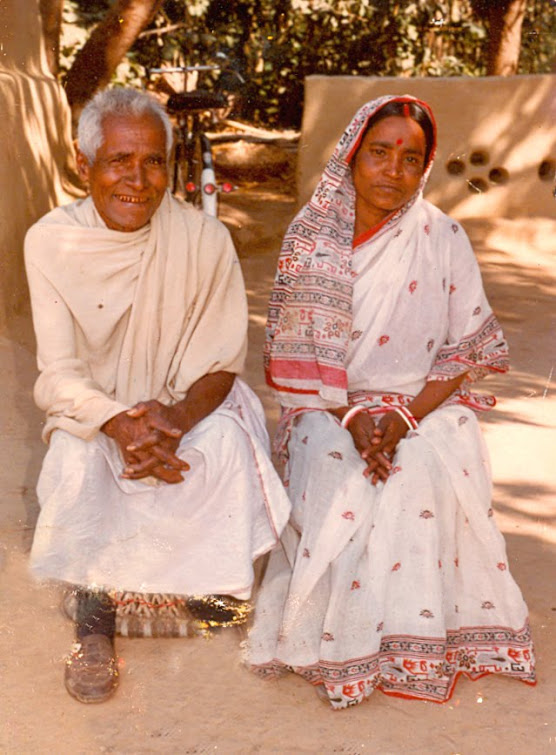
While my Parents Pulin babu and Basanti devi were living
Showing posts with label US. Show all posts
Showing posts with label US. Show all posts
Thursday, September 24, 2009


Wednesday, September 23, 2009
EU, WTO, US, Caste System and Nandigram
EU, WTO, US, Caste System and Nandigram
Indian Holocaust my Father`s Life and Time - sixty Five
Palash Biswas
Congress workers burn an effigy of the West Bengal Chief Minister Buddhadeb Bhattacharjee, to protest the police firing and the death of farmers in Nandigram on Thursday. Farmers angry over plans to build an industrial park on their land torched a g overnment office on Thursday. Naxals
Under pressure from the US and European Union, India on Wednesday hinted that it was open to the idea of reducing customs duties on wines and spirits.
“India wants to avoid the matter going to the WTO’s dispute settlement body. I hope a solution can be found as the matter is being discussed at the highest level,” Commerce and Industry Minister Kamal Nath said after meeting EU Agriculture Commissioner Mariann Fischer Boel.
Both the EU and US have threatened to move the dispute settlement mechanism of the World Trade Organisation (WTO) over customs duties India imposes on imported wine and distilled spirits. The effective duty on imported wine and distilled spirits such as whisky range from approximately 150 per cent to 550 per cent.
The US has said in the WTO, India has committed that its tariffs on wine and spirits will not exceed 150 per cent.
Naxalite s Kill Police Men
On the other hand, At least fifty security personnel were feared killed and as many as 13 others were injured when Naxalites attacked a police outpost located in Bijapur district of Chhattisgarh during the wee hours of Thursday. The armed Maoists fled after looting weapons.According to the police sources, the Naxals came in large numbers and hurled grenades and petrol bombs besides opening indiscriminate fire on the security forces in the base camp at around 2 am.
“There were around eighty security personnel in the Rani Bodli base camp including 26 Chhattisgarh Armed Forces personnel and 55 Special Police Officers (SPOs) at the time of attack,” the source stated.The security personnel retaliated the Naxal attack, resulting in the death of nearly six of the extremists, a senior police official said.
Speaking to Hindustan Times, the state's home minister, Ram Vichar Netam, expressed fear that the casualty figures could be high. Senior police officials and paramilitary forces rushed to the spot following the massacre.Dantewada District Collector KR Pisda informed that around fifty dead bodies were recovered but they were yet to be identified.
Government plans to create hundreds of low-tax Special Economic Zones (SEZs) across India -- touted as a way to industrialise India -- could end up in tatters as farmers fight any acquisition of their lands in Nandigram.
The centrist, reform-minded government coalition of Prime Minister Manmohan Singh of the Congress party relies on a group of four leftist parties commonly known as the Left Front for a majority in parliament.
Those leftist parties are now worried about a backlash from their own grassroots over the promotion of SEZs at the cost of farmers' lands and are bickering among themselves.
Within the Left Front, smaller left parties have slammed India's biggest communist party, the Communist Party of India (Marxist) (CPI-M), which governs West Bengal and which tried to set up the industry hub on land in Nandigram belonging to thousands of farmers.
"No industry can be developed on the basis of corpses of peasants," Communist Party of India (CPI) General Secretary A.B. Bardhan told Reuters in Kolkata, in a rare blunt criticism of his longtime ally.
With the coalition's leftist partners fighting, Prime Minister Singh's Congress party-led government will not be able to rely on their support for economic reforms ahead of national elections in 2009.
Leftist parties have asked the government to put a cap on the number of SEZs as well as on the amount of land that can be taken for them.
"Without these amendments, SEZs are an imposition on the people," Bardhan said.
The central government had already put a hold on 230 SEZ approvals following violence earlier this year in Nandigram.
Some analysts expect the CPI(M), embarrassed by the Nandigram violence, would step up its opposition to reforms in the pension sector or to foreign players entering the retails sector to try and boost its socialist credentials.
"To bolster its credentials and override criticism of its smaller left-wing allies over the SEZs, one can expect a lot more barking from the CPI(M) against the central government," said Pran Chopra, a New Delhi-based political commentator.
India's leftists are not expected to pull support from the Congress party, as they fear that would bring back their ideological enemy, the Hindu-nationalist Bharatiya Janata Party, back in power.
WEST BENGAL STRONGHOLD
In recent years, reformist CPI(M) West Bengal chief minister Buddhadeb Bhattacharjee has been wooing investors, resulting in technology companies flocking to the eastern state.
But his push to set up SEZs has met bloody resistance, especially in Nandigram in the southwest of the state, where at least 21 people have been killed in clashes since January.
The CPI(M)'s leftist allies say the pro-farmer image of the leftist parties that rule three of India's 29 states is getting tarred by the West Bengal government's actions.
"The way the government has tackled the issue is anti-people," said Asok Ghosh, state chief of the pro-communist All India Forward Bloc in West Bengal.
But a senior CPI(M) politician said authorities had to act in Nandigram where villagers, egged on by opposition political activists, were not allowing the state to operate for weeks.
"Is Nandigram a liberated zone? How can the government give up its authority due to a fear psychosis created by anti-government elements?" party MP Mohammad Saleem said.
Organising Bahujan unions on “caste identity” to destroy Brahminism
KOVENA, 7-141, MITTAPALEM STREET, GUDUR, NELLORE DT., AP - 524 101
We do not appear to have given much importance to Babasaheb Ambedkar’s Third Commandment, “Organize”. India is a subcontinent of many nationalities and sub-nationalities with all sorts of diversities — physical, linguistic, caste, social and cultural. Unity among such diverse nationalities is impossible for any concerted movement/action. It can only be done caste-wise and state-wise. No doubt our Editor, V.T. Rajshekar, has offered a wonderful solution: caste (Caste — A Nation Within the Nation, Books for Change, Bangalore, 2002). Even the Caste solution offered by him has nothing to say on “organize”. The problem is even the caste system is different in different states. The Telugu castes are not there in any other state. So also Kannada and Tamil castes. Taking these realities and the essence of Editor Rajshekar’s Caste book into consideration, I have prepared a proforma union for each caste in each linguistic state. In AP, it will be “Telugu Bahujan Union” differing from state to state. DV should call for debate before we start organising.
Huge Muslim turn-out, A Dalit Voice report
OUR CORRESPONDENT
Bangalore: The city on Feb.17, 2007 witnessed a huge Muslim conference. What marked the massive turn-out (over one lakh) was that it comprised young, energetic, disciplined and yet angry Muslims. Politicians were scrupulously kept out. It was a gathering of revolutionary youth from the three Southern states of Kerala, Karnataka and Tamil Nadu. As expected the Brahminical papers blackedout the whole event. Nor was there any TV coverage. The Hindu terrorists from the RSS however were shocked by the discipline of the crowd which hardly had a person over 50. A person close to the Hindu terrorists said he was simply shocked by the military-discipline. How could the idli-sambar chaddi boys face such a motivated Muslim youth, he said. The police said the three-day meet in the sprawling Palace Grounds was incident free. However, some upper caste anti-Muslim elements did infiltrate in the name of secularism, a meaningless word in “Hindu India”, and this was unavoidable in a huge turn-out like this. The conference was inaugurated by a British journalist Alan Hart, whose writings are familiar to DV members and addressed by a Black Muslim scholar from Washington, Dr. Hodari Ali. The organisers — the Kerala-based Popular Front of India — being close to us we had to be associated with the three-day event from beginning to end. And we met hundreds of friends and admirers from all parts of India. Quite a number of them belonged to the DV family. What attracted such a huge turn-out? It is the Muslim fear of the Brahminical terrorist RSS-BJP getting a foothold for the first time in South India — thanks to H.D. Deve Gowda, a former Prime Minister and a rank fascist. His craze for power and pelf made him hand over the state to the Brahmana Jati Party (BJP), which is controlling the state, though his son is a name-sake CM. And to further strengthen their hold on the state and widen their sphere of influence they are planning to convert Karnataka into another Gujarat. The coastal Karnataka district, the stronghold of Hindu terrorists, is supplying the brain and muscle power. The peace-loving Muslims, already reduced to destitution, are deeply worried. This is the cause of the huge turnout at the Feb.17 conference.
AN APPEAL FROM NANDIGRAM AND KOLKATA/ March 15, 2007
AS CPM RUNS AROUND FOR A SCAPEGOAT, POLICE & CADRES KILL 125 IN NANDIGRAM MASSACRE: PEOPLE CALL TO STAND BY STRUGGLE
As the death count of March 14 carnage in Nandigram by the W.Bengal Police and CPM cadres has reached 125, the people, organizations and activists of Nandigram and Kolkata called upon all the people , who value the democracy, human rights and equality of freedom to come to Nandigram and be with the struggling people.
Though the cadres of the ruling Communist Party (Marxist) are blocking the way, the High Court Order on March 15, asks the government to facilitate the people to visit the area for enquiry of help. "The people must show their resolve against the Fascist ways of the so called progressive government and party" said Samar Das, a senior activist from National Alliance of People's Movements (NAPM), W. Bengal.
The ruling CPM through its cadres has imposed an undeclared censorship on the media and people. It is indulging in double crime – first by beating the Nandigram people to pulp and killing them. But it does not wish the nation or people to see what is happening. " Its like Stalinist days, when you are not allowed to say that there is injustice nor others are allowed to hear or film it", says Mr.Das.
And the great Red-wash effort is on. Their cadres and their septuagenarian elite are afraid to own up the responsibility of this police action. The CPM bosses are making the same statements which a Narendra Modi or Sunderlal Patwa or Sharad Pawar make. Same 'outsider hand',. same 'Naxalites' and very same Opposition people 'who do not want to see W. Bengal to progress'.
While the power holders in CPM have themselves ordered the large police contingent with a planned strategy of carnage on such a large scale, they are now finding everyone else to blame. If only repairs and 'restoring the civil society' had been their objective, did it need 3000 police force with AK-47 rifles? So they have devised the new excuse of 'people exploding bombs on police'. They are in power and that power to like totalitarian state. No one in W. Bengal can go to a Government hospital or school and college, if he or she is not in good books of the CPM boss in that area. And people making the bombs do not undertake protest actions.
There was statewide denunciation of the CPM act. Its own allies in state government, Revolutionary Socialist Party and Forward Bloc called for 'bandh', while the Communist Party of India (CPI) severely criticized the carnage and the decision to send such large posse of police. The intellectuals, artists, social and political workers of all hues have rapped the state government action. The Governor, Mr. Gopal Gandhi, called the killing as " horror" and wanted the state government to restrain itself.
It is Bloodbath, War on People.
About 125-130 men, women and children were killed by the police and the cadres of the ruling Communist Party of India (CPM). Many dead bodies were thrown by police into the nearby river. The dead bodies of children were thrown onto the trenches dug by the villagers to stop any encroachment, and they were filled with soil to make roads – like post-Godhra carnage in Gujarat. According to the people the cadres and police have devastated the Sonachura village; they killed the people, drove them out, looted the houses and raped scores of women. People are seething with anger against the CPM cadres. It is bloodbath; it's a war on people " said Sumit Chowdhury, renowned writer and journalist.
In fact all the villages are ransacked, devastated by the cadres and police. They have blocked entry to journalists and other organizations and one journalist was kidnapped and intimidated to keep quiet. Armed CPI(M) cadres are mixed with the police, fired upon villagers and then attempted to enter the villages. Another group of party activists cordoned off the entire area checked all vehicles to prevent journalists from entering the scene of violence. Several scribes were beaten up. "We wont allow the media to enter the village. So far you were running the show. Now it is our turn," East Midnapur CPM chief and M.P. Lakshman Seth said bluntly.
On March 14, over a 2000-strong police force armed with AK 47 rifles attempted to enter Nandigram, which has been cut off from the rest of the state for over two months now by villagers resisting land acquisition for setting up an SEZ. The first barricade was put up by women and children who resisted the police from entering the villages. The police fired tear gas shells and then rubber bullets and finally live cartridges.
The sudden raid came as a surprise for the villagers as they started running here and there to maintain a safe distance. It was a horrific sight as armed policemen were seen dragging villagers out of their houses and beating them.
"It is like a war. I don't know where my family members are. I never expected such an attack from the policemen," Saber, one of the villagers of Gorchakraberia said. Around 10 am the entire area turned into a battlefield. "I can see every were bodies are scattered all over paddy field smeared with blood. Those who were injured are screaming for help but instead of providing any aid policemen were seen kicking them with their boots," Ehsan one of the local villagers told a journalist over telephone.
Nandigram, Tamluk hospitals were ill-equipped to treat this barrage of injured people. Most of the victims are women and children (in school uniform too). Many contacts in Nandigram are putting the number of injured above 200. All these people were brought to the hospitals by the relatives and neighbors. Police on the spot have not helped even a single victim to avail medical help. There are many more injured lying in the interior villages, unable to move out for want of any means of transport and also for apprehension of getting killed if found by the marauders.
The Plan
The plan to push in police into the trouble-torn and tense area was chalked out by the CPI(M) top brass last Saturday. They were under pressure from the East Midnapur unit of the party led by MP Lakshman Seth who felt that the CPI(M) would permanently lose ground in the area unless barricades were removed and 'normalcy' was restored in Nandigram. A large section of the CPI(M) secretariat was also of the same view and felt that the manner villagers were keeping the administration paralyzed for over two months was creating a bad precedent.
According to the strategy, the police was asked to remove resistance, enter the villages and 'restore law of the land'. They were to be followed by CPI(M) activists, who would "reinstall civil society" in Nandigram. According to Samar Das, unprecedented police force – more than 3000, came on the periphery of Nandigram, " Police were drawn from all districts in Bengal. They have what they wanted to do. Now, we must be here, to be with the Nandigram people - from all over India. "
"No one is 'outsier' here. All are Indians and human beings. It is mischievous on part of Buddnadeb, Biman BAsu and their Sitaram Yechry to all others as outsiders. A true Marxist would never call anyone like that. Ask Sitaram Yechury, an M.P. from Bengal, where he is from? The CPM is becoming offenive out of its guilt complex" said Manav Kamnble, a prominent Dalit social activist in Pune, while addressing a meeting held on on March 15 to condemn the Nandigram carnage and announce Action 2007 of NAPM.
Similarly. large numbers of activists and organizations protested at CPM office in Mumbai. The Sarovidaya activists protested in many district places in Maharashtra. These protests would go on increasing, till the CPM comes to senses and talks with the people.
Sanjay Sangvai
__._,_.___
Pressure on govt, Maran latest to slam SEZ freeze
As pressure builds on the empowered group of ministers led by External Affairs Minister Pranab Mukherjee to take an early decision on the contentious special economic zone issue, it was today Information Technology Minister Dayanidhi Maran's turn to slam the freeze on SEZ approvals.
Following violent protests over land acquisition in West Bengal and Uttar Pradesh, the Centre had decided to put on hold all SEZ notifications and approvals till a national relief and rehabilitation policy was formulated.
Speaking to reporters on the sidelines of a seminar on 'Saving Doha and Delivering on Development' here on Thursday, Maran urged the Centre to clear proposals "at least where companies have their own land."
He added that companies like Nokia and Flextronics, which wish to set up ancillary units in Tamil Nadu to manufacture keypads and other parts, were adversely affected by the freeze. "There are at least ten pending proposals for setting up of ancillary units which are yet to be cleared," he said.
The prime minister and the EGoM have also received strongly-worded missives from the chief ministers of Tamil Nadu, Andhra Pradesh, Karnataka and Gujarat over the last few weeks urging the de-freezing of SEZ approvals.
The delay in clearing SEZ proposals could dissuade investors and had already thrown a spanner in the works of several firms who had invested in equipment, they argued.
The EGoM's decision is likely to impact 173 SEZs, including 63 SEZs which have been notified by the government.
Clash in Nandigram again, Mamata alleges attack
SEZ freeze to remain till UP elections are over
KG NARENDRANATH & MK VENU
TIMES NEWS NETWORK[ THURSDAY, MARCH 15, 2007 03:54:29 AM]
NEW DELHI: The freeze on new SEZ approvals may not be lifted soon. Indications are that the UPA government might go slow on the matter till, at least, the UP elections are over. This is despite that chief ministers of many states such as Tamil Nadu, Andhra Pradesh, Gujarat and Karnataka have intensified the pressure on the Centre to clear pending SEZ proposals, especially those for which land has been acquired, as they fear the current deadlock could dampen investor enthusiasm.
In separate letters to commerce and industry minister Kamal Nath, at least three chief ministers — M Karunanidhi, Narendra Modi and HD Kumaraswamy — have voiced their concern over the freeze caused by the political decision of the ruling UPA not to notify, or approve, any new proposals till a relief and rehabilitation (R&R) policy for farmers being dispossessed by these projects is evolved at the national level.
However, commerce secretary GK Pillai told ET: “It is unlikely that the approval mechanism will resume soon. If things continue to be in a limbo for long, investments could dry up. Potential investors might shift to other countries.” Even in the case of 171 applicants who had got formal nods after land acquisition, the wait for the final notification might not end soon. “I’m concerned about 171 proposals for which land is tied up and formal nods have already been given. It is a different matter for the remaining 162,” Mr Pillai said.
Meanwhile, Andhra Pradesh chief minister YS Rajasekhara Reddy wrote to the external affairs minister Pranab Mukherjee, who heads the group of ministers (GoM) on SEZs, urging him to expedite notification of already approved SEZs with no pending land acquisition, or R&R issues. Mr Reddy made a strong pitch for the apparel city Sri Lanka’s Brandix proposes to set up at Visakhapatnam wherein 60,000 people are likely to be employed.
In an attempt to counter the criticism that SEZs would hit the farming sector, Mr Reddy said in the letter: “I would like to inform you that Andhra Pradesh has about 2.75 lakh sq km of area which is more than twice that of West Bengal and Tamil Nadu but has only 30% of its arable land provided with irrigation facilities. Even if 1.5 lakh hectares of land is devoted to industry in the next 10 years, this will constitute less than 0.24% of the total land mass of the state.” He said the state government was nevertheless “making every effort to see that no irrigated land is acquired unless absolutely unavoidable”.
Mr Karunanidhi’s letter to Kamal Nath said that the sudden halt in the process of SEZ approvals has sent wrong signals to the investor community. “Many SEZ proposals from Tamil Nadu, which are backed by sound manufacturing investments, have been put on hold. Any delay in taking a decision would have adverse impact on investor confidence and investment,” Mr Karunanidhi said. Tamil Nadu has four SEZs that are operational and has so far obtained nods for 44 SEZs — 16 with in-principle nods, 18 with formal approvals and 10 already notified.
Stating that Bangalore is emerging as a hub for aerospace-related industries (global avionics majors such as EADS, Spirit Aero System and homegrown companies such as Dynamatic Technologies and Shobha Nadathur Aerospace have shown interest in setting up units in Bangalore), Karnataka CM Kumaraswamy sought speedy approval for an aviation cluster zone near the new Bangalore International Airport.
Mr Kumaraswamy noted that land acquisition process for the sector-specific SEZ to be set up by the state government had made a headway. Mr Modi has sought an exemption from the current freeze on approval for the apparel SEZ being planned on sick textile mills’ land in Ahmedabad which is expected to generate 35,000 jobs.
ibnlive.com
Posted Thursday , March 15, 2007 at 16:24
POLITICS OF VIOLENCE: Injured farmers and Mamata recuperate in a Nandigram hospital.
New Delhi: Fresh violence rocked Nandigram village on Thursday as police fired in the air and lobbed tear gas shells on relatives at a hospital where those injured in Wednesday's firing are being treated.The police action started virtually minutes after West Bengal Chief Minister Buddhadeb Bhattacharjee called Wednesday's violence unfortunate in the state Assembly.
Adding pressure on the Chief Minister, Calcutta High Court in a suo motu action has ordered a CBI inquiry into the police firing that claimed 14 lives so far.
After the hospital commotion, Trinamool Congress chief Mamata Bannerjee was hospitalised when she complained of chest pain after allegedly being hit by a stone while on her way to areas affected by the violence.
"Mamata had to be admitted to Nandigram hospital after she complained of chest pain when she was hit by a stone on her way to Nandigram," a Trinamool Congress leader Anuradha Putatunda said.
Putatunda alleged that Mamta's convoy was repeatedly blocked and attacked by CPI-M supporters who have been picketing on all the roads towards Nandigram.
Demanding the Chief Minister’s resignation for "creating unrest" in West Bengal, Mamata said that she would continue the agitation against farmland acquisition in the state.
Meanwhile, a block development office in Nandigram was set on fire by Trinamool Congress workers.
Nandigram issue stalls Parliament
The Left parties found themselves cornered in Parliament on the killing of farmers in Nandigram in West Bengal as they faced a determined attack by the Opposition which stalled proceedings of both Houses demanding dismissal of the CPI-M-led state government.
Both the Lok Sabha and the Rajya Sabha saw several adjournments before calling it a day as the BJP-Shiv Sena in the Lower House and the saffron party and the Trinamool Congress in the Upper House created a furor targeting the Left.
Buddhadeb briefs PM on Nandigram violence
Kolkata, March. 15 (PTI): West Bengal Chief Minister Buddhadev Bhattacharjee today briefed Prime Minister Manmohan Singh about the violence in Nandigram that claimed 14 lives and sent a report on the incident to the Centre.
"I briefed the Prime Minister of what actually happened at Nandigram over telephone," Bhattacharjee told reporters at his chamber in the Assembly.
He said he had also spoken to Union Home Minister Shivraj Patil and External Affairs Minister Pranab Mukherjee, a senior Congress leader from West Bengal.
Bhattacharjee said the situation in Nandigram was slowly returning to normal and his government would not take any hasty step in the area.
Violence erupted in Nandigram after the state government yesterday sent in police to restore order in villages where people had dug up and blocked roads to prevent the entry of the men in uniform after protests against the acquisition of land for industries.
Asked about the token participation of the Left Front's allies RSP and CPI in the debate on the motion of thanks to the Governor's Address to the Assembly, Bhattacharjee said: "I have noted this and will take it up at the Left Front meeting."
Asserting that he would not budge from his stand on the setting up of a Tata Motors' plant in Singur, Bhattacharjee said, "There is no question of backing out (on the project)."
He said he wanted the Opposition to cooperate with the government in advancing industrialisation. "I reiterate my appeal to the Opposition to cooperate with the administration to industrialse the state in every possible manner."
Asked to comment on Governor Gopalkrishna Gandhi's virtual indictment of his government for the violence in Nandigram, Bhattacharjee declined to comment.
Nandigram incident has created deep crisis in LF: Bardhan
Kolkata, March. 15 (PTI): The "unprecedented" police firing in Nandigram has created a deep crisis within West Bengal's ruling Left Front, CPI General Secretary A B Bardhan said today.
Describing yesterday's police action as the "most tragic and unprecedented" incident during the 30-year rule of the Left Front in the state, Bardhan, who rushed here to attend CPI's state secretariat meeting, said there should be transparency and consultations with partners in the coalition on government action.
The "brutal" police action was unusual and unacceptable. It was a "unilateral" step taken in a hurried manner, he said.
The anguish expressed by Governor Gopalkrishna Gandhi had come at an appropriate time, he said.
The resistance at Nandigram, Bardhan said, was a result of the people's protest against the attempt by the state government to set up a chemical hub there.
He said that, in a way, the chemical industry was being exported from developed countries like Japan and Germany to third world nations. "Why should they pollute our state?" he asked.
"Although we are working within a bourgeois set-up, but as leftists we should put up some model for others," he said.
Nath defends SEZs, says land acquisition led to violence
New Delhi, March. 15 (PTI): Commerce and Industry Minister Kamal Nath today defended the SEZ policy of the Centre and said land acquisition, which led to violence in Nandigram, should be equitable and transparent.
"The land acquisition for all industrial purposes should be equitable, transparent and inclusive of farmers," he told reporters.
He said the incident in Nandigram was unfortunate. However, the SEZ policy should not be held responsible for it.
"Yesterday's incidents in West Bengal are unfortunate... we should not look at it as SEZ issue but one of land acquisition for industrial projects," he said, referring to the protests by activists against SEZs in Nandigram leading to police firing in which 11 people were killed and 75 injured.
Asked whether yesterday's violence could slow down the fresh approvals on SEZs, Nath said in many pending cases there was no dispute and promoters have already tied-up land.
The empowered Group of Ministers on SEZs headed by External Affairs Minister Pranab Mukkerjee could not meet since January and there is a freeze on fresh approvals and notifications.
Nath said when eGoM meets next it would look "distinctively" at the cases where land was not an issue and where acquisition was a problem. However, there is uncertainty over the next meeting of the GoM. In most of the pending 172 cases awaiting notification, the land has been tied up without any protests.
In fact, five Chief Ministers and some Union Ministers have written to the eGoM to notify the pending cases.
He said the Centre has asked the State Governments to provide details of land acquisition. When the reply is received it would be placed before the eGoM for directions on future of SEZs.
Nandigram: Left cornered, Opposition stalls proceedings
New Delhi, March. 15 (PTI): The Left parties today found themselves cornered in Parliament on the killing of farmers in Nandigram in West Bengal as they faced a determined attack by the Opposition which stalled proceedings of both Houses demanding dismissal of the CPI(M)-led State Government.
Both the Lok Sabha and the Rajya Sabha saw several adjournments before calling it a day as the BJP-Shiv Sena in the Lower House and the saffron party and the Trinamool Congress in the Upper House created a furore targeting the Left.
No business could be transacted in either House in spite of the fact that in the Lok Sabha Finance Minister P Chidambaram was to reply to the discussion on the General Budget.
The ruling side had issued a three-line whip for the purpose.
Despite being key outside allies of the UPA, neither the Congress nor any other party in the ruling alliance came out to offer a helping hand to the Left.
A couple of days ago in the Lok Sabha, the Maritime University Bill controversy had left the Left embarrassed due to conduct of its members.
It was trouble from the word go today in both the Houses which saw slogans like "Communists are murderers" and "Communist high-handedness will not be tolerated" being raised by the Opposition which stormed the well in the Lok Sabha.
Uproar over Nandigram killings, RS adjourns for day
New Delhi, March 15. (PTI): Uproar over the killing of farmers in police firing at Nandigram in West Bengal today stalled proceedings in the Rajya Sabha leading to its adjournment for the day.
Right from the word go, angry opposition members did not allow the House to run forcing its first adjournment for an hour within minutes of its assembling.
BJP and other opposition members shouting slogans against the Left Front West Bengal Government raked up the issue again when the House reassembled at noon.
As Deputy Chairman K Rahman Khan called for tabling of papers, the entire opposition stood up to raise the issue.
Sensing the mood, the Chair adjourned the House for the day.
Trouble began in the Upper House when Leader of the Opposition Jaswant Singh rose to speak on the issue.
As soon as Singh stood up, Brinda Karat (CPI-M) asked Chairman Bhairon Singh Shekhawat under what rule the issue, a state subject, was being raised.
This triggered an angry reaction from BJP members who raised slogans.
Lone Trinamool Congress member Dinesh Trivedi sought suspension of the Question Hour to take up discussion on the issue.
Congress members, however, raised slogans "we want Question Hour".
Sensing the mood, Shekhawat adjourned the House till 1200 hours.
CPI(M) ready for CBI probe into Nandigram firing
New Delhi, March. 15 (PTI): Facing flak for the police firing on villagers in Nandigram, the CPI(M) today said its government in West Bengal was "absolutely open" for any transparent probe including by the CBI to bring out the "truth".
Indian Holocaust my Father`s Life and Time - sixty Five
Palash Biswas
Congress workers burn an effigy of the West Bengal Chief Minister Buddhadeb Bhattacharjee, to protest the police firing and the death of farmers in Nandigram on Thursday. Farmers angry over plans to build an industrial park on their land torched a g overnment office on Thursday. Naxals
Under pressure from the US and European Union, India on Wednesday hinted that it was open to the idea of reducing customs duties on wines and spirits.
“India wants to avoid the matter going to the WTO’s dispute settlement body. I hope a solution can be found as the matter is being discussed at the highest level,” Commerce and Industry Minister Kamal Nath said after meeting EU Agriculture Commissioner Mariann Fischer Boel.
Both the EU and US have threatened to move the dispute settlement mechanism of the World Trade Organisation (WTO) over customs duties India imposes on imported wine and distilled spirits. The effective duty on imported wine and distilled spirits such as whisky range from approximately 150 per cent to 550 per cent.
The US has said in the WTO, India has committed that its tariffs on wine and spirits will not exceed 150 per cent.
Naxalite s Kill Police Men
On the other hand, At least fifty security personnel were feared killed and as many as 13 others were injured when Naxalites attacked a police outpost located in Bijapur district of Chhattisgarh during the wee hours of Thursday. The armed Maoists fled after looting weapons.According to the police sources, the Naxals came in large numbers and hurled grenades and petrol bombs besides opening indiscriminate fire on the security forces in the base camp at around 2 am.
“There were around eighty security personnel in the Rani Bodli base camp including 26 Chhattisgarh Armed Forces personnel and 55 Special Police Officers (SPOs) at the time of attack,” the source stated.The security personnel retaliated the Naxal attack, resulting in the death of nearly six of the extremists, a senior police official said.
Speaking to Hindustan Times, the state's home minister, Ram Vichar Netam, expressed fear that the casualty figures could be high. Senior police officials and paramilitary forces rushed to the spot following the massacre.Dantewada District Collector KR Pisda informed that around fifty dead bodies were recovered but they were yet to be identified.
Government plans to create hundreds of low-tax Special Economic Zones (SEZs) across India -- touted as a way to industrialise India -- could end up in tatters as farmers fight any acquisition of their lands in Nandigram.
The centrist, reform-minded government coalition of Prime Minister Manmohan Singh of the Congress party relies on a group of four leftist parties commonly known as the Left Front for a majority in parliament.
Those leftist parties are now worried about a backlash from their own grassroots over the promotion of SEZs at the cost of farmers' lands and are bickering among themselves.
Within the Left Front, smaller left parties have slammed India's biggest communist party, the Communist Party of India (Marxist) (CPI-M), which governs West Bengal and which tried to set up the industry hub on land in Nandigram belonging to thousands of farmers.
"No industry can be developed on the basis of corpses of peasants," Communist Party of India (CPI) General Secretary A.B. Bardhan told Reuters in Kolkata, in a rare blunt criticism of his longtime ally.
With the coalition's leftist partners fighting, Prime Minister Singh's Congress party-led government will not be able to rely on their support for economic reforms ahead of national elections in 2009.
Leftist parties have asked the government to put a cap on the number of SEZs as well as on the amount of land that can be taken for them.
"Without these amendments, SEZs are an imposition on the people," Bardhan said.
The central government had already put a hold on 230 SEZ approvals following violence earlier this year in Nandigram.
Some analysts expect the CPI(M), embarrassed by the Nandigram violence, would step up its opposition to reforms in the pension sector or to foreign players entering the retails sector to try and boost its socialist credentials.
"To bolster its credentials and override criticism of its smaller left-wing allies over the SEZs, one can expect a lot more barking from the CPI(M) against the central government," said Pran Chopra, a New Delhi-based political commentator.
India's leftists are not expected to pull support from the Congress party, as they fear that would bring back their ideological enemy, the Hindu-nationalist Bharatiya Janata Party, back in power.
WEST BENGAL STRONGHOLD
In recent years, reformist CPI(M) West Bengal chief minister Buddhadeb Bhattacharjee has been wooing investors, resulting in technology companies flocking to the eastern state.
But his push to set up SEZs has met bloody resistance, especially in Nandigram in the southwest of the state, where at least 21 people have been killed in clashes since January.
The CPI(M)'s leftist allies say the pro-farmer image of the leftist parties that rule three of India's 29 states is getting tarred by the West Bengal government's actions.
"The way the government has tackled the issue is anti-people," said Asok Ghosh, state chief of the pro-communist All India Forward Bloc in West Bengal.
But a senior CPI(M) politician said authorities had to act in Nandigram where villagers, egged on by opposition political activists, were not allowing the state to operate for weeks.
"Is Nandigram a liberated zone? How can the government give up its authority due to a fear psychosis created by anti-government elements?" party MP Mohammad Saleem said.
Organising Bahujan unions on “caste identity” to destroy Brahminism
KOVENA, 7-141, MITTAPALEM STREET, GUDUR, NELLORE DT., AP - 524 101
We do not appear to have given much importance to Babasaheb Ambedkar’s Third Commandment, “Organize”. India is a subcontinent of many nationalities and sub-nationalities with all sorts of diversities — physical, linguistic, caste, social and cultural. Unity among such diverse nationalities is impossible for any concerted movement/action. It can only be done caste-wise and state-wise. No doubt our Editor, V.T. Rajshekar, has offered a wonderful solution: caste (Caste — A Nation Within the Nation, Books for Change, Bangalore, 2002). Even the Caste solution offered by him has nothing to say on “organize”. The problem is even the caste system is different in different states. The Telugu castes are not there in any other state. So also Kannada and Tamil castes. Taking these realities and the essence of Editor Rajshekar’s Caste book into consideration, I have prepared a proforma union for each caste in each linguistic state. In AP, it will be “Telugu Bahujan Union” differing from state to state. DV should call for debate before we start organising.
Huge Muslim turn-out, A Dalit Voice report
OUR CORRESPONDENT
Bangalore: The city on Feb.17, 2007 witnessed a huge Muslim conference. What marked the massive turn-out (over one lakh) was that it comprised young, energetic, disciplined and yet angry Muslims. Politicians were scrupulously kept out. It was a gathering of revolutionary youth from the three Southern states of Kerala, Karnataka and Tamil Nadu. As expected the Brahminical papers blackedout the whole event. Nor was there any TV coverage. The Hindu terrorists from the RSS however were shocked by the discipline of the crowd which hardly had a person over 50. A person close to the Hindu terrorists said he was simply shocked by the military-discipline. How could the idli-sambar chaddi boys face such a motivated Muslim youth, he said. The police said the three-day meet in the sprawling Palace Grounds was incident free. However, some upper caste anti-Muslim elements did infiltrate in the name of secularism, a meaningless word in “Hindu India”, and this was unavoidable in a huge turn-out like this. The conference was inaugurated by a British journalist Alan Hart, whose writings are familiar to DV members and addressed by a Black Muslim scholar from Washington, Dr. Hodari Ali. The organisers — the Kerala-based Popular Front of India — being close to us we had to be associated with the three-day event from beginning to end. And we met hundreds of friends and admirers from all parts of India. Quite a number of them belonged to the DV family. What attracted such a huge turn-out? It is the Muslim fear of the Brahminical terrorist RSS-BJP getting a foothold for the first time in South India — thanks to H.D. Deve Gowda, a former Prime Minister and a rank fascist. His craze for power and pelf made him hand over the state to the Brahmana Jati Party (BJP), which is controlling the state, though his son is a name-sake CM. And to further strengthen their hold on the state and widen their sphere of influence they are planning to convert Karnataka into another Gujarat. The coastal Karnataka district, the stronghold of Hindu terrorists, is supplying the brain and muscle power. The peace-loving Muslims, already reduced to destitution, are deeply worried. This is the cause of the huge turnout at the Feb.17 conference.
AN APPEAL FROM NANDIGRAM AND KOLKATA/ March 15, 2007
AS CPM RUNS AROUND FOR A SCAPEGOAT, POLICE & CADRES KILL 125 IN NANDIGRAM MASSACRE: PEOPLE CALL TO STAND BY STRUGGLE
As the death count of March 14 carnage in Nandigram by the W.Bengal Police and CPM cadres has reached 125, the people, organizations and activists of Nandigram and Kolkata called upon all the people , who value the democracy, human rights and equality of freedom to come to Nandigram and be with the struggling people.
Though the cadres of the ruling Communist Party (Marxist) are blocking the way, the High Court Order on March 15, asks the government to facilitate the people to visit the area for enquiry of help. "The people must show their resolve against the Fascist ways of the so called progressive government and party" said Samar Das, a senior activist from National Alliance of People's Movements (NAPM), W. Bengal.
The ruling CPM through its cadres has imposed an undeclared censorship on the media and people. It is indulging in double crime – first by beating the Nandigram people to pulp and killing them. But it does not wish the nation or people to see what is happening. " Its like Stalinist days, when you are not allowed to say that there is injustice nor others are allowed to hear or film it", says Mr.Das.
And the great Red-wash effort is on. Their cadres and their septuagenarian elite are afraid to own up the responsibility of this police action. The CPM bosses are making the same statements which a Narendra Modi or Sunderlal Patwa or Sharad Pawar make. Same 'outsider hand',. same 'Naxalites' and very same Opposition people 'who do not want to see W. Bengal to progress'.
While the power holders in CPM have themselves ordered the large police contingent with a planned strategy of carnage on such a large scale, they are now finding everyone else to blame. If only repairs and 'restoring the civil society' had been their objective, did it need 3000 police force with AK-47 rifles? So they have devised the new excuse of 'people exploding bombs on police'. They are in power and that power to like totalitarian state. No one in W. Bengal can go to a Government hospital or school and college, if he or she is not in good books of the CPM boss in that area. And people making the bombs do not undertake protest actions.
There was statewide denunciation of the CPM act. Its own allies in state government, Revolutionary Socialist Party and Forward Bloc called for 'bandh', while the Communist Party of India (CPI) severely criticized the carnage and the decision to send such large posse of police. The intellectuals, artists, social and political workers of all hues have rapped the state government action. The Governor, Mr. Gopal Gandhi, called the killing as " horror" and wanted the state government to restrain itself.
It is Bloodbath, War on People.
About 125-130 men, women and children were killed by the police and the cadres of the ruling Communist Party of India (CPM). Many dead bodies were thrown by police into the nearby river. The dead bodies of children were thrown onto the trenches dug by the villagers to stop any encroachment, and they were filled with soil to make roads – like post-Godhra carnage in Gujarat. According to the people the cadres and police have devastated the Sonachura village; they killed the people, drove them out, looted the houses and raped scores of women. People are seething with anger against the CPM cadres. It is bloodbath; it's a war on people " said Sumit Chowdhury, renowned writer and journalist.
In fact all the villages are ransacked, devastated by the cadres and police. They have blocked entry to journalists and other organizations and one journalist was kidnapped and intimidated to keep quiet. Armed CPI(M) cadres are mixed with the police, fired upon villagers and then attempted to enter the villages. Another group of party activists cordoned off the entire area checked all vehicles to prevent journalists from entering the scene of violence. Several scribes were beaten up. "We wont allow the media to enter the village. So far you were running the show. Now it is our turn," East Midnapur CPM chief and M.P. Lakshman Seth said bluntly.
On March 14, over a 2000-strong police force armed with AK 47 rifles attempted to enter Nandigram, which has been cut off from the rest of the state for over two months now by villagers resisting land acquisition for setting up an SEZ. The first barricade was put up by women and children who resisted the police from entering the villages. The police fired tear gas shells and then rubber bullets and finally live cartridges.
The sudden raid came as a surprise for the villagers as they started running here and there to maintain a safe distance. It was a horrific sight as armed policemen were seen dragging villagers out of their houses and beating them.
"It is like a war. I don't know where my family members are. I never expected such an attack from the policemen," Saber, one of the villagers of Gorchakraberia said. Around 10 am the entire area turned into a battlefield. "I can see every were bodies are scattered all over paddy field smeared with blood. Those who were injured are screaming for help but instead of providing any aid policemen were seen kicking them with their boots," Ehsan one of the local villagers told a journalist over telephone.
Nandigram, Tamluk hospitals were ill-equipped to treat this barrage of injured people. Most of the victims are women and children (in school uniform too). Many contacts in Nandigram are putting the number of injured above 200. All these people were brought to the hospitals by the relatives and neighbors. Police on the spot have not helped even a single victim to avail medical help. There are many more injured lying in the interior villages, unable to move out for want of any means of transport and also for apprehension of getting killed if found by the marauders.
The Plan
The plan to push in police into the trouble-torn and tense area was chalked out by the CPI(M) top brass last Saturday. They were under pressure from the East Midnapur unit of the party led by MP Lakshman Seth who felt that the CPI(M) would permanently lose ground in the area unless barricades were removed and 'normalcy' was restored in Nandigram. A large section of the CPI(M) secretariat was also of the same view and felt that the manner villagers were keeping the administration paralyzed for over two months was creating a bad precedent.
According to the strategy, the police was asked to remove resistance, enter the villages and 'restore law of the land'. They were to be followed by CPI(M) activists, who would "reinstall civil society" in Nandigram. According to Samar Das, unprecedented police force – more than 3000, came on the periphery of Nandigram, " Police were drawn from all districts in Bengal. They have what they wanted to do. Now, we must be here, to be with the Nandigram people - from all over India. "
"No one is 'outsier' here. All are Indians and human beings. It is mischievous on part of Buddnadeb, Biman BAsu and their Sitaram Yechry to all others as outsiders. A true Marxist would never call anyone like that. Ask Sitaram Yechury, an M.P. from Bengal, where he is from? The CPM is becoming offenive out of its guilt complex" said Manav Kamnble, a prominent Dalit social activist in Pune, while addressing a meeting held on on March 15 to condemn the Nandigram carnage and announce Action 2007 of NAPM.
Similarly. large numbers of activists and organizations protested at CPM office in Mumbai. The Sarovidaya activists protested in many district places in Maharashtra. These protests would go on increasing, till the CPM comes to senses and talks with the people.
Sanjay Sangvai
__._,_.___
Pressure on govt, Maran latest to slam SEZ freeze
As pressure builds on the empowered group of ministers led by External Affairs Minister Pranab Mukherjee to take an early decision on the contentious special economic zone issue, it was today Information Technology Minister Dayanidhi Maran's turn to slam the freeze on SEZ approvals.
Following violent protests over land acquisition in West Bengal and Uttar Pradesh, the Centre had decided to put on hold all SEZ notifications and approvals till a national relief and rehabilitation policy was formulated.
Speaking to reporters on the sidelines of a seminar on 'Saving Doha and Delivering on Development' here on Thursday, Maran urged the Centre to clear proposals "at least where companies have their own land."
He added that companies like Nokia and Flextronics, which wish to set up ancillary units in Tamil Nadu to manufacture keypads and other parts, were adversely affected by the freeze. "There are at least ten pending proposals for setting up of ancillary units which are yet to be cleared," he said.
The prime minister and the EGoM have also received strongly-worded missives from the chief ministers of Tamil Nadu, Andhra Pradesh, Karnataka and Gujarat over the last few weeks urging the de-freezing of SEZ approvals.
The delay in clearing SEZ proposals could dissuade investors and had already thrown a spanner in the works of several firms who had invested in equipment, they argued.
The EGoM's decision is likely to impact 173 SEZs, including 63 SEZs which have been notified by the government.
Clash in Nandigram again, Mamata alleges attack
SEZ freeze to remain till UP elections are over
KG NARENDRANATH & MK VENU
TIMES NEWS NETWORK[ THURSDAY, MARCH 15, 2007 03:54:29 AM]
NEW DELHI: The freeze on new SEZ approvals may not be lifted soon. Indications are that the UPA government might go slow on the matter till, at least, the UP elections are over. This is despite that chief ministers of many states such as Tamil Nadu, Andhra Pradesh, Gujarat and Karnataka have intensified the pressure on the Centre to clear pending SEZ proposals, especially those for which land has been acquired, as they fear the current deadlock could dampen investor enthusiasm.
In separate letters to commerce and industry minister Kamal Nath, at least three chief ministers — M Karunanidhi, Narendra Modi and HD Kumaraswamy — have voiced their concern over the freeze caused by the political decision of the ruling UPA not to notify, or approve, any new proposals till a relief and rehabilitation (R&R) policy for farmers being dispossessed by these projects is evolved at the national level.
However, commerce secretary GK Pillai told ET: “It is unlikely that the approval mechanism will resume soon. If things continue to be in a limbo for long, investments could dry up. Potential investors might shift to other countries.” Even in the case of 171 applicants who had got formal nods after land acquisition, the wait for the final notification might not end soon. “I’m concerned about 171 proposals for which land is tied up and formal nods have already been given. It is a different matter for the remaining 162,” Mr Pillai said.
Meanwhile, Andhra Pradesh chief minister YS Rajasekhara Reddy wrote to the external affairs minister Pranab Mukherjee, who heads the group of ministers (GoM) on SEZs, urging him to expedite notification of already approved SEZs with no pending land acquisition, or R&R issues. Mr Reddy made a strong pitch for the apparel city Sri Lanka’s Brandix proposes to set up at Visakhapatnam wherein 60,000 people are likely to be employed.
In an attempt to counter the criticism that SEZs would hit the farming sector, Mr Reddy said in the letter: “I would like to inform you that Andhra Pradesh has about 2.75 lakh sq km of area which is more than twice that of West Bengal and Tamil Nadu but has only 30% of its arable land provided with irrigation facilities. Even if 1.5 lakh hectares of land is devoted to industry in the next 10 years, this will constitute less than 0.24% of the total land mass of the state.” He said the state government was nevertheless “making every effort to see that no irrigated land is acquired unless absolutely unavoidable”.
Mr Karunanidhi’s letter to Kamal Nath said that the sudden halt in the process of SEZ approvals has sent wrong signals to the investor community. “Many SEZ proposals from Tamil Nadu, which are backed by sound manufacturing investments, have been put on hold. Any delay in taking a decision would have adverse impact on investor confidence and investment,” Mr Karunanidhi said. Tamil Nadu has four SEZs that are operational and has so far obtained nods for 44 SEZs — 16 with in-principle nods, 18 with formal approvals and 10 already notified.
Stating that Bangalore is emerging as a hub for aerospace-related industries (global avionics majors such as EADS, Spirit Aero System and homegrown companies such as Dynamatic Technologies and Shobha Nadathur Aerospace have shown interest in setting up units in Bangalore), Karnataka CM Kumaraswamy sought speedy approval for an aviation cluster zone near the new Bangalore International Airport.
Mr Kumaraswamy noted that land acquisition process for the sector-specific SEZ to be set up by the state government had made a headway. Mr Modi has sought an exemption from the current freeze on approval for the apparel SEZ being planned on sick textile mills’ land in Ahmedabad which is expected to generate 35,000 jobs.
ibnlive.com
Posted Thursday , March 15, 2007 at 16:24
POLITICS OF VIOLENCE: Injured farmers and Mamata recuperate in a Nandigram hospital.
New Delhi: Fresh violence rocked Nandigram village on Thursday as police fired in the air and lobbed tear gas shells on relatives at a hospital where those injured in Wednesday's firing are being treated.The police action started virtually minutes after West Bengal Chief Minister Buddhadeb Bhattacharjee called Wednesday's violence unfortunate in the state Assembly.
Adding pressure on the Chief Minister, Calcutta High Court in a suo motu action has ordered a CBI inquiry into the police firing that claimed 14 lives so far.
After the hospital commotion, Trinamool Congress chief Mamata Bannerjee was hospitalised when she complained of chest pain after allegedly being hit by a stone while on her way to areas affected by the violence.
"Mamata had to be admitted to Nandigram hospital after she complained of chest pain when she was hit by a stone on her way to Nandigram," a Trinamool Congress leader Anuradha Putatunda said.
Putatunda alleged that Mamta's convoy was repeatedly blocked and attacked by CPI-M supporters who have been picketing on all the roads towards Nandigram.
Demanding the Chief Minister’s resignation for "creating unrest" in West Bengal, Mamata said that she would continue the agitation against farmland acquisition in the state.
Meanwhile, a block development office in Nandigram was set on fire by Trinamool Congress workers.
Nandigram issue stalls Parliament
The Left parties found themselves cornered in Parliament on the killing of farmers in Nandigram in West Bengal as they faced a determined attack by the Opposition which stalled proceedings of both Houses demanding dismissal of the CPI-M-led state government.
Both the Lok Sabha and the Rajya Sabha saw several adjournments before calling it a day as the BJP-Shiv Sena in the Lower House and the saffron party and the Trinamool Congress in the Upper House created a furor targeting the Left.
Buddhadeb briefs PM on Nandigram violence
Kolkata, March. 15 (PTI): West Bengal Chief Minister Buddhadev Bhattacharjee today briefed Prime Minister Manmohan Singh about the violence in Nandigram that claimed 14 lives and sent a report on the incident to the Centre.
"I briefed the Prime Minister of what actually happened at Nandigram over telephone," Bhattacharjee told reporters at his chamber in the Assembly.
He said he had also spoken to Union Home Minister Shivraj Patil and External Affairs Minister Pranab Mukherjee, a senior Congress leader from West Bengal.
Bhattacharjee said the situation in Nandigram was slowly returning to normal and his government would not take any hasty step in the area.
Violence erupted in Nandigram after the state government yesterday sent in police to restore order in villages where people had dug up and blocked roads to prevent the entry of the men in uniform after protests against the acquisition of land for industries.
Asked about the token participation of the Left Front's allies RSP and CPI in the debate on the motion of thanks to the Governor's Address to the Assembly, Bhattacharjee said: "I have noted this and will take it up at the Left Front meeting."
Asserting that he would not budge from his stand on the setting up of a Tata Motors' plant in Singur, Bhattacharjee said, "There is no question of backing out (on the project)."
He said he wanted the Opposition to cooperate with the government in advancing industrialisation. "I reiterate my appeal to the Opposition to cooperate with the administration to industrialse the state in every possible manner."
Asked to comment on Governor Gopalkrishna Gandhi's virtual indictment of his government for the violence in Nandigram, Bhattacharjee declined to comment.
Nandigram incident has created deep crisis in LF: Bardhan
Kolkata, March. 15 (PTI): The "unprecedented" police firing in Nandigram has created a deep crisis within West Bengal's ruling Left Front, CPI General Secretary A B Bardhan said today.
Describing yesterday's police action as the "most tragic and unprecedented" incident during the 30-year rule of the Left Front in the state, Bardhan, who rushed here to attend CPI's state secretariat meeting, said there should be transparency and consultations with partners in the coalition on government action.
The "brutal" police action was unusual and unacceptable. It was a "unilateral" step taken in a hurried manner, he said.
The anguish expressed by Governor Gopalkrishna Gandhi had come at an appropriate time, he said.
The resistance at Nandigram, Bardhan said, was a result of the people's protest against the attempt by the state government to set up a chemical hub there.
He said that, in a way, the chemical industry was being exported from developed countries like Japan and Germany to third world nations. "Why should they pollute our state?" he asked.
"Although we are working within a bourgeois set-up, but as leftists we should put up some model for others," he said.
Nath defends SEZs, says land acquisition led to violence
New Delhi, March. 15 (PTI): Commerce and Industry Minister Kamal Nath today defended the SEZ policy of the Centre and said land acquisition, which led to violence in Nandigram, should be equitable and transparent.
"The land acquisition for all industrial purposes should be equitable, transparent and inclusive of farmers," he told reporters.
He said the incident in Nandigram was unfortunate. However, the SEZ policy should not be held responsible for it.
"Yesterday's incidents in West Bengal are unfortunate... we should not look at it as SEZ issue but one of land acquisition for industrial projects," he said, referring to the protests by activists against SEZs in Nandigram leading to police firing in which 11 people were killed and 75 injured.
Asked whether yesterday's violence could slow down the fresh approvals on SEZs, Nath said in many pending cases there was no dispute and promoters have already tied-up land.
The empowered Group of Ministers on SEZs headed by External Affairs Minister Pranab Mukkerjee could not meet since January and there is a freeze on fresh approvals and notifications.
Nath said when eGoM meets next it would look "distinctively" at the cases where land was not an issue and where acquisition was a problem. However, there is uncertainty over the next meeting of the GoM. In most of the pending 172 cases awaiting notification, the land has been tied up without any protests.
In fact, five Chief Ministers and some Union Ministers have written to the eGoM to notify the pending cases.
He said the Centre has asked the State Governments to provide details of land acquisition. When the reply is received it would be placed before the eGoM for directions on future of SEZs.
Nandigram: Left cornered, Opposition stalls proceedings
New Delhi, March. 15 (PTI): The Left parties today found themselves cornered in Parliament on the killing of farmers in Nandigram in West Bengal as they faced a determined attack by the Opposition which stalled proceedings of both Houses demanding dismissal of the CPI(M)-led State Government.
Both the Lok Sabha and the Rajya Sabha saw several adjournments before calling it a day as the BJP-Shiv Sena in the Lower House and the saffron party and the Trinamool Congress in the Upper House created a furore targeting the Left.
No business could be transacted in either House in spite of the fact that in the Lok Sabha Finance Minister P Chidambaram was to reply to the discussion on the General Budget.
The ruling side had issued a three-line whip for the purpose.
Despite being key outside allies of the UPA, neither the Congress nor any other party in the ruling alliance came out to offer a helping hand to the Left.
A couple of days ago in the Lok Sabha, the Maritime University Bill controversy had left the Left embarrassed due to conduct of its members.
It was trouble from the word go today in both the Houses which saw slogans like "Communists are murderers" and "Communist high-handedness will not be tolerated" being raised by the Opposition which stormed the well in the Lok Sabha.
Uproar over Nandigram killings, RS adjourns for day
New Delhi, March 15. (PTI): Uproar over the killing of farmers in police firing at Nandigram in West Bengal today stalled proceedings in the Rajya Sabha leading to its adjournment for the day.
Right from the word go, angry opposition members did not allow the House to run forcing its first adjournment for an hour within minutes of its assembling.
BJP and other opposition members shouting slogans against the Left Front West Bengal Government raked up the issue again when the House reassembled at noon.
As Deputy Chairman K Rahman Khan called for tabling of papers, the entire opposition stood up to raise the issue.
Sensing the mood, the Chair adjourned the House for the day.
Trouble began in the Upper House when Leader of the Opposition Jaswant Singh rose to speak on the issue.
As soon as Singh stood up, Brinda Karat (CPI-M) asked Chairman Bhairon Singh Shekhawat under what rule the issue, a state subject, was being raised.
This triggered an angry reaction from BJP members who raised slogans.
Lone Trinamool Congress member Dinesh Trivedi sought suspension of the Question Hour to take up discussion on the issue.
Congress members, however, raised slogans "we want Question Hour".
Sensing the mood, Shekhawat adjourned the House till 1200 hours.
CPI(M) ready for CBI probe into Nandigram firing
New Delhi, March. 15 (PTI): Facing flak for the police firing on villagers in Nandigram, the CPI(M) today said its government in West Bengal was "absolutely open" for any transparent probe including by the CBI to bring out the "truth".
Subscribe to:
Posts (Atom)
