The Ambedkarite Buddhists of Maharashtra
"Twenty-five centuries ago India witnessed an intellectual and religious revolution which culminated in the overthrow of monotheism, priestly selfishness, and the establishment of a synthetic religion, a system of light and thought which was appropriately called Dhamma - Philosophical Religion." - Anagarika Dharmapala
The History:
In 1935 at Nasik district, Maharashtra, Dr.Babasaheb Ambedkar had declared his firm resolve to change his religion. He had declared that he was born as a Hindu but will not die as Hindu. Dr.Ambedkar stated “Conversion is not a game of children. It is not a subject of entertainment. It deals with how to make man's life successful. Just as a boatman has to make all necessary preparations before he starts for voyage, so also we have to make preparations. Unless I get an idea as to how many persons are willing to leave the Hindu fold, I cannot start preparations for conversion”.
Why Conversion-“If we can gain freedom by conversion, why should we shoulder the responsibility of reforming the Hindu religion? And why should we sacrifice our strength and property for that? None should misunderstand the object of our movement as being Hindu social reform. The object of our movement is to achieve social freedom for the untouchables. It is equally true that this freedom cannot be secured without conversion.
After almost twenty years of his firm resolve to leave Hinduism, Dr Ambedkar embraced Buddhism, along with lakhs of his followers on 14th October 1956 at Nagpur, Maharashtra. “After this function, each one should give initiation to each one. Every Buddhist man has the authority to give initiation, this I proclaim”, said Dr Ambedkar.
Altough there are many Buddhists in India including the original Buddhists of ladakh, Sikkim etc, I am confining my discussion to the mass followers of Dr Ambedkar who have converted to Buddhism at his appeal.
The Mahars of Maharashtra:
The Mahar community was among the majority of followers of Dr Ambedkar who converted to Buddhism. The community followed the footsteps of their leader and took keen interest in education and availed the benefit of reservation in government services. Today the community has IAS, IPS, IRS, bank officers, psu executives, doctors, IIT & IIM professionals working in corporate sector, many working and settled abroad. This community certainly had the greater responsibility of carrying the mission of Boddhisatva Babasaheb Ambedkar forward.
The Christians contribute 12% of their monthly earnings to the church. Are the Buddhists of Maharashtra ready to contribute a part of their earnings for spreading Buddhism? The benificiarfies of Ambedkarite Movement are still not ready to contribute 5% of their earnings for the social cause as appealed for by Dr Ambedkar. Can one expect them to come ahead for contributing for Buddhism? Though the Buddha himself never preached to win converts, are we ready at least to take Buddhism to rural India?
The Buddha travelled to places miles away to give sermons and discourses, but today majority of bhantes keep themselves confined in viharas or wait for people to invite and call them for any function. In The Buddha and his Dhamma, Dr Ambedkar states-
The question that arises is—" Did the Buddha have no Social Message? "
* When pressed for an answer, students of Buddhism refer to the two points.
They say— “The Buddha taught Ahimsa.", “The Buddha taught peace!"
* Asked—" Did the Buddha give any other Social Message?”-
- “Did the Buddha teach justice? ", "Did the Buddha teach love?", "Did the Buddha teach liberty?" "Did the Buddha teach equality?" “Did the Buddha teach fraternity? ";" Could the Buddha answer Karl Marx? "
These questions are hardly ever raised in discussing the Buddha's Dhamma.. My answer is that the Buddha has a Social Message. He answers all these questions. But they have been buried by modern authors.
Dr. Ambedkar had said, he would make India Buddhist again. (mee bharat buddha maya Karen).Who were these people, Ambedkar had in mind? Whom was he to teach his religion? Obviously, all the poor depressed and deprived people of this land divided by tradition into thousands of castes, the SCs, STs, OBCs, and other smaller deprived under-privileged groups.
If one analyses the majority of organisations formed by the mahars of Maharashtra, it can be seen that they have confined themselves only to one community. If the dream of babasaheb has to be fulfilled, Buddhism needs to be spread among the majority of people. Those who work only for one community they will not have any other work than asking and pleading. They can never have self respect and hence cannot run a self reliant movement. Those who keep on asking and pleading have to understand that in democracy, the minority cannot send its representatives to parliament. When Dr Ambedkar said “we want to become a ruling class and i will make india once again a Buddhist country” was he saying this on the support of small minority of Mahars ? Regrettably, the Buddhists of Maharashtra have done and been doing exactly opposite of what he wanted them to do. They have confined Buddha to only their community and that too half heartedly. While Dr Ambedkar gave
them 22 Vows at the time of conversion, the most important among them being refraining from worshipping Hindu gods and goddesses, they still find place in majority of homes of mahars. Even if one finds the idol of Buddha in drawing room, the inside search will reveal hidden Hindu gods and goddesses in their homes. It is their responsibility to spread Buddhism among at least the other castes under the scheduled castes of Maharashtra like the matangs, charmakars etc leave apart the ST’s and OBC’s. But they have reduced the most dynamic and appealing religion of the world “’Buddhism” to a religion of small community.
Buddhist practices:
Various ceremonies in the households of maharashtrian Buddhists are held in the presence of bhante (Buddhist Monk) if available or any other person who can recite trisharan and panchasheel can perform the ceremony as bhante’s are always not available in rural areas. Occasions like shifting to a new house, naming ceremony of a new born baby, etc are celebrated by calling a Buddhist bhante or dhammachari. Various small booklets are available in market on how to observe and celebrate various occasions as per Buddhism. Dr Ambedkar himself published 1956 'Bauddha Pooja Path' a Manual for Buddhist Worship, in Pali and Marathi for the benefit and guidance of Buddhists. While it is really nice to see Buddhists following Buddhists way of celebrating occasions, the same Buddhists can be seen celebrating hindu festivals like diwali, holi and ganpati. I have come across many so called Buddhists in Maharashtra who still
worship hindu Gods and Godesses and celebrate all Hindu festivals.
Vipassana and Meditation:
Now this is the topic which i have been avoiding so many days to write upon. I am neither a Buddhist scholar nor a vipassana practioner. But I can certainly take the privilege of being an educated person with enough wisdom to judge certain things based on my knowledge and experience. The first thing which came to my mind while writing about vipassana and meditation is why I am writing on this? Are all the problems being faced by my community since thousand of years solved? Has the subjugation, deprivation, discrimination and untouchability abolished from India? Has the whole of scheduled caste community in Maharashtra risen above hunger and poverty to such a level that they have now enough time to do vipassana and meditation? If the answer to the entire above question is in negation than why are the Buddhists of Maharashtra so much after vipassana.
Warning by Dr. Babasaheb Ambedkar:
At Rangun in 1954, Dr. Ambedkar clarified important aspect “ In regard to the preparation of Buddha’s gospel care must be taken to emphasize the social and moral teaching of the Buddha. I have to emphasize this. What is emphasized is meditation, contemplation and abhidhammas. This way of presenting Buddhism to Indians would be fatal to our cause”.
In The Buddha and his dhamma, Dr Ambedkar stated “What is the teaching of the Buddha? To some, Samadhi is his principal teaching. To some it is Vipassana (a kind of pranayama).This divergence of views are those of man who have a FANCY for certain things. Such are those, who regard that the essence of Buddhism lies in Samadhi or Esoterism. He further elaborated that “Samma Samadhi is not the same as Samadhi, It is quite different. Samadhi is mere concentration. No doubt it leads to Dhyanic states which are self-induced, holding the five hindrances in suspense. But these Dhyana states are temporary. Consequently the suspension of the hindrances is also temporary. What is necessary is a permanent turn to the mind. Such a permanent turn can be achieved only by Samma Samadhi.
“Mere Samadhi is negative inasmuch as it leads to temporary suspension of the hindrances. In it there is no training to the mind. Samma Samadhi is positive. It trains the mind to concentrate and to think of some Kusala Kamma (Good Deeds and Thoughts) during concentration and thereby eliminate the tendency of the mind to be drawn towards Akusala Kamma (Bad Deeds and Bad Thoughts) arising from the hindrances.
Ashoka instead of imposing stringent restrictions on social evils could have employed trained Bhikkus for teaching Vipassana to help people come out of their misery. Or else, like any other messages he would have created on such rock edict inscribed with the message of propagating the Dhamma through Vipassana. In life time of Ashoka, he did not do it. The teachings of Buddha are eternal, but even then Buddha did not proclaim them to be infallible. The religion of Buddha has the capacity to change according to times; a quality which no other religion can claim to have...Now what is the basis of Buddhism? If you study carefully, you will see that Buddhism is based on reason. There is an element of flexibility inherent in it, which is not found in any other religion.
Bhadant Nagarjuna Surai Sasai, a Buddhist monk who is also a member of the National Minority Commission, has not said Vipassana meditation is against Babasaheb Ambedkar’s Buddhism.He said Dr. Ambedkar wrote about meditation nor ever did meditation. The vipassana course launched by a Hindu Marwadi S.N.Goenka was nothing but an attempt to destroy the revolutionary character of Ambedkarite Buddhism.
Nobody has seen Dr. Ambedkar doing meditation. He has no time for such a Brahminical pastime. Nor did we read anywhere about meditation in his voluminous writings. How then the Vipassanawalas can claim that meditation is a part of Buddhism?
Dr K. Jamnadas says on the issue of secret pact of Goenka with shankaracharya “We are not criticizing Vipassana or Goenka just for the sake of criticism. We are merely asking: Are the Ambedkarites willing to accept Goenka as their representative for talks with Hindu leaders? Why this secrecy? Should there be no review and debate over it? Why the vipassis are silent on this point. This is my feeling. I personally feel the agreement" is more to the liking of the RSS—Samrasta Manch's ideas of "status quo" and would hamper spread of Budhism. I will be happy if I am wrong”.
When a farmer ploughing his field or a doctor carrying out operation gets so engrossed/concentra ted in his work that, it becomes itself a meditation/vipassan a for him. Hence, claiming that Vipassana helps in better concentration is a lopsided view borne out of the inadequate understanding of Buddhism.
Shri Hadke says “Let us assume that we do not believe Vipassana and as such do not attend 10 days or so, Vipassana camp. Are we losing something physically or mentally? Is it really unavoidable or very essential (like food, water and oxygen)? I say certainly not! Because Dr. Ambedkar says,” As far as nature is concerned, man is free. So he should have independent philosophy.” Alternatively, we can develop qualities through vast reading of our saviour’s literature/philosop hy. In long run, we have good qualities through reading, Igatpuri’s Vipassana is a sort of picnic to people, they get happiness for a while, as if, Vipassanists have been given opium to get his instant happiness and rest of the time he would busy in repairing his physical body or would be so much addicted that he would quit life, as nature cannot forgive anybody”.
The Buddha is one of the great reformers of human history. He refused to promote mystical, occult and secret doctrines. He exposed the emptiness and futility of performing rites and rituals as a means of gaining salvation. He thought that people should not be bound to a holy book or sacred ritual in the search for truth and to gain spiritual liberation. Buddha proclaimed to the world the immense potential and the invincible power of the human mind. Instead of placing man in a subservient position to some conception or personification of a divine power, he showed how man can attain the highest knowledge and supreme enlightenment by his own efforts. He raised the worth of man by showing how one can develop one’s potential and attain Buddha-hood is attained through spiritual maturity and not through mere prayers, worship or making offerings to a supernatural being.
There are some who follow Goenka, who runs Vippasana centres. His followers, in most parts, are lost to Ambedkarism. This is because most of them have dissociated themselves from the Amedkarite movement. (There are exceptions, salutes to them.) There is nothing wrong, per se, in Vippasana. But they think, Vippasana is the only teaching that the Buddha taught. There are followers of Osho, who run Dhyana Centers. Their activities are such that the majority of population disapproves. There are some Ambedkarites praising Osho also. These two groups, the Goenka and Osho followers are condemned by authors like Yashwant Manohar as "pollutions" among the Ambedkarite movements.
One of my Buddhist friends gave a very nice example what Buddha himself would have done in today’s scenario. When Buddha himself did meditation there were no scientific discoveries. But today Buddha would have various alternatives. He would have gone to internet cafe, surfed the net for ways to remove human suffering, visited international universities and libraries, discussed and debated with intellectuals and so on...
He would certainly not have done vipassana sitting idle for weeks and months to find solution to human suffering. The educated Ambedkarites need to be careful while discussing the tenets of Buddhism. Even the great scholars and scientists of world have acknowledged Buddhism as the most scientific religion and the maharashtrain Buddhists are discussing Vibrations and Tarangs being produced due to meditation in their discourses.
We have so many issues to be resolved, so many constructive works to be done which could take Ambedkarism to its pinnacle. Can’t we discuss about how would be our economic policy if we come to power? Especially when the Economic thoughts of Dr Ambedkar are so relevant even in today’s scenario. What would be our Education policy for the Bahujans of India? Globalisation and its impact on our people, the Primary Health Policy and its effective implementation? Shall we continue with the caste based reservations in Government Jobs when majority of Beneficiaries are not paying back to society? Can we introduce a PBST (Pay back to society Tax) for beneficiaries of reservation just like FBT? Is there any necessity to continue reservation in parliament and legislative assemblies which even Dr Ambedkar wanted to be abolished after ten years? And so on...
My honest opinion is that the talk and practice of vipassana is an easy escape route found by the Belly filled Maharsahtrian Buddhists to avoid the greater task of spreading Phule-Shahu- Ambedkarite ideology in every nook and corner of country especially rural India. Those intellectuals and learned Buddhists talking too much about Buddhism are never seen visiting villages and educating the masses about the time tested ideology of Phule and Shahu or even Buddhism. Simply giving discourses to urban people that to only to Mahar community will certainly not revive Buddhism in India. One of my Buddhist friends who recently visited USA informed me that the Maharashtrian Buddhists who are settled there are still looking for sub caste wise matrimonial alliances for their wards.
In this age of madness of collecting, donating and spending millions on religious festivals, I wish to quote Dr Ambedkar-“In his inaugural address at the all India Sai Devotees Convention held at Bombay in 1954, He said that “It has become a profession to collect money in the name of religion and waste it on purposes for which there is no social justification. There is so much poverty and misery in the world that it is criminal to collect money in the name of religion and waste it on feeding Brahmins and other pilgrims”.
Buddhism to the untouchables of Maharashtra is known only because of Dr Ambedkar. To overemphasize Buddhism ignoring the teachings and ideology of Dr Ambedkar can lead us nowhere. Before Babasaheb we were nothing, he showed us the way from darkness to light. If the task of spreading Buddhism in India is analysed in the recent past, then TBMS is doing a fine job. I shall not comment much on different yanas or practices followed by Buddhists but like to narrate an Incident which should clear the doubts of naive Buddhists.
During conversion days, Dr. Ambedkar was interviewed by "Tarun Bharat" a daily from Nagpur, asking him which 'yana' he professes. Dr. Ambedkar said his propagation of Buddhism depends upon the original teachings of the Buddha. The traditional teachings have been corrupted during the course of time by the views of various Teachers of different sects. I am putting forward the teachings in proper perspective. 'Tarun Bharat' correspondent said "then we can call this a 'Bhim yaan'. Ambedkar said 'No! If you want to give it a new name, you may call it "Nava yaan", but what I propagate is according to original teachings of Buddha, and is based on rational thinking."
During my tenure at Assam, I met a Buddhist monk from Thailand who came there for some research. I told him about the Ambedkarite Buddhists, their economical conditions, the rural Buddhists etc. After listening to me, he told me one incident wherein he met one Bengali Brahmin family who were so impressed by the Buddha’s teachings that they wanted to become Buddhists, but told him that if they become Buddhists people will think they belong to the untouchable’s community, scheduled castes. I was shocked by the way that thai monk showed him to overcome this dilemma. He advised them to tell people that they follow Goenka’s Buddhism then people will respect them.
Buddhist organisations in Maharashtra:
Like the political parties, the Buddhists of maharshtra are divided into different Buddhist organisations like the Akhil bhartiya boudh mahasabha, kokan boudhajan panchayat, trailokya boudh maha sangh(TBMS) and various other Buddhist organisations. There is absolutely no harm in different Buddhists organisations existing as long as they don’t distort the original teachings of Buddha and Buddhism as envisaged by Dr Ambedkar. While the RSS has followed and effectively implemented the concept of SANGHA, one can see the lack of coordination, uniformity and a real SANGHA among the numerous Buddhists organisations. While there is absolutely no harm in having different Buddhists organisations, they should at least have some common goal, uniformity in practices of dhamma and coordination.
Today there are many young enthusiastic Buddhists among the maharashtrian Ambedkarites. Some are top professionals from premier institutes exchanging ideas and discussing Buddhism through various e- forums on internet. Month long discussions running into numerous threads of e mails are happening as to whether Buddha taught vipassana, whether Dr Ambedkar practised meditation, whether there is concept of rebirth in Buddhism etc. The young and enlightened Buddhists are travelling throughout the world attending international Buddhists conferences, meeting international delegates and discussing Buddhism. Is this the way are we going to revive Buddhism in India? Was this the objective of Dr Ambedkar while conversion to Buddhism? I had e mail correspondence with one such young ambedkarite Buddhist who frequently travels abroad for Buddhists conferences. He was so much concerned about the Dalai Lama, Tibetan refugees and Tibetan Buddhists in India that at one
point of time I thought that all the problems of millions of our scheduled castes, tribes, obc,s who have been subjugated since thousands of years and still continuing are solved and now it is only the Tibetan Buddhists who need our support. When I asked this same query to that gentleman he vanished like anything from the mails. There are also some high flying Buddhists Ambassadors who frequently meet the Dalai Lama, click photographs with him and at the same time find the saviour in and methods of sri sri ravi Shankar more effective and convincing that any other Ambedkarite principle.
Not everyone is engaged in the illusionary talks of vipassana or meditation. I have met one IRS officer, an Ambedkarite Buddhist in Maharashtra who is spreading the 22 Vows campaign to every corner of Maharashtra. His task I find really a tough one for it emphasises on 22 Vows given by Dr Ambedkar at the time of Deeksha which majority of Buddhists try to avoid. Still he is doing a commendable work. Another beauraucrat from vidharbha has done a commendable job of organising sc’s in yavatmal district and cultivating a habit among them to weekly visit the Buddha Vihara. The yearly samata parva organised by him draws huge crowd.
The golden jubilee year of diksha ceremony at Nagpur has seen the largest number of dhamma parishads in Maharashtra. There is nothing wrong in that. But the unique feature of majority of dhamma parishads was that the occasion was used by various political parties who sponsored the event. Political leaders were seen sitting with the bhante’s , large cut outs of political leaders at the venue was a regular feature at this parishads. Some Bhante’s are well known for their political affilations with the Congress and NCP. The Congress/NCP are also aware that politically their dreams are shattered by the recent developments at national level politics, the rise and growing popularity of BSP hence they are infiltrating through the sangha.
Some Buddhists who are following Buddhism give the impression whether Buddhism is really a part of Hinduism or what. They practice some days, pujas exactly as the hindus do. I have seen banners such as ‘Buddha Vihar Jirnoddar samiti’ on the streets of Mumbai.
The Mahabodhi Vihar Mukti Andolan is continuing since years. One Ambedkarite leader well known for his proximity to Congress party said that he has become the governor of Bihar just to free the Mahabodhi vihar at gaya from the Hindus. He silently accepted transfer to another state. It is for the Ambedkarites to decide how much sincere his motive was.
One Buddhist MLA from Nagpur, belonging to congress party has been demanding Buddhist marriage act since long. It is difficult to understand why his masters in congress are not accepting his demand when his party is in power in state as well as centre.
I personally had to face the wrath of my own Buddhists friends who were not comfortable with the idea of monthly meeting at Assam to discuss Buddhism, social issues and how we can contribute to resolve it. Their contention was that they know everything about Buddhism and what Ambedkar thaught and why do they need to meet monthly for this. Moreover there was a big objection to meeting on Sundays (the only holiday) and the afternoon timing which was a relaxing time for them.
The worst incident which can be cited here is that of a “DikshaBhoomi Parivar” (a small group formed by Buddhists of Vidarbha settled in Navi Mumbai and Thane) yearly picnic to karnala, in Navi Mumbai. As informed by my friends who unfortunately went with them just looking at the name of group, they were shocked to see the group members mainly Government employees, consuming Alcohol and partying sitting beside the big Banner titled” DikshaBhoomi Parivar Sahal”. When they objected that they should at least not use the word ‘Dikshabhoomi’ the place where Dr Ambedkar took Diksha at Nagpur, and do such activities, they were asked to get out of the place and mind their own business by the drunken group members.
The Ambedkarite Buddhists certainly need to decide their priorities. What is needed first? Social transformation through continuous awakening of the downtrodden, attainment of political power which a key to annihilate all our age old sufferings or spreading the teachings of Buddha?
Dr Jamnadas has rightly stated that “there are two aims facing the today’s Ambedkarites. First is to spread the religion to the masses, and second is to teach what is "proper" Buddhism of Ambedkar's mind, which needs to be followed. Faced with this dual task, we have to analyze how we are behaving. We have also to decide our priorities”.
Those scheduled castes that are still to accept Buddhism, the path of emancipation shown by their messiah, those who enjoy and continue deriving benefit from the relentless struggle by Dr Ambedkar, whether it is reservation or life with dignity must read the history as what Dr Ambedkar said before conversion. He said that “Conversion is not for slaves. Those who desire to live in obedience to the dictates of the Hindus, those who wish to remain their slaves; they do not need to think over this problem. But those who wish to live a life of self-respect, and equality, will have to think over this”.
India can not become Buddhist without political power:
Now is the stage to unite all "Dalitbahujans" and capture the political power. India can only become Buddhist through political power. Let us remember the examples of Ashoka, Kanisha, Harsha and Palas. In the present scenario; this is not a distant dream. Unless and until we have political power, we have to keep pleading, submitting memorandums & representations to those who never ever endeavour to take cognizance of it. The Buddhists of Maharashtra had enough of Vipassana and Meditation. Time has come to seriously contemplate as to where the Ambedkarite movement is heading. Shall we confine and limit Buddhism to one caste and create hatred with other backward and oppressed castes so that organisations like RSS take advantage and create a situation like Orissa where the Christians (Scheduled Tribes) are killed by their own brethren( Schedules
castes and Hindu Tribes)?.
It is for the Ambedkarite Buddhists to think and ponder…
Jaibhim and Regards
Abhay Madhukar Dongre
References:
1) The Buddha and His Dhamma- Dr B.R.Ambedkar
2) How India Will Become Once Again Buddhist? Dr K. Jamanadas,
3) Vipassana and Buddhist Movement- Vinod Vanjari
4) Debate on Buddhism- Dalit Voice.
5) Why Conversion- Dr B.R.Ambedkar.

Memories of Another day
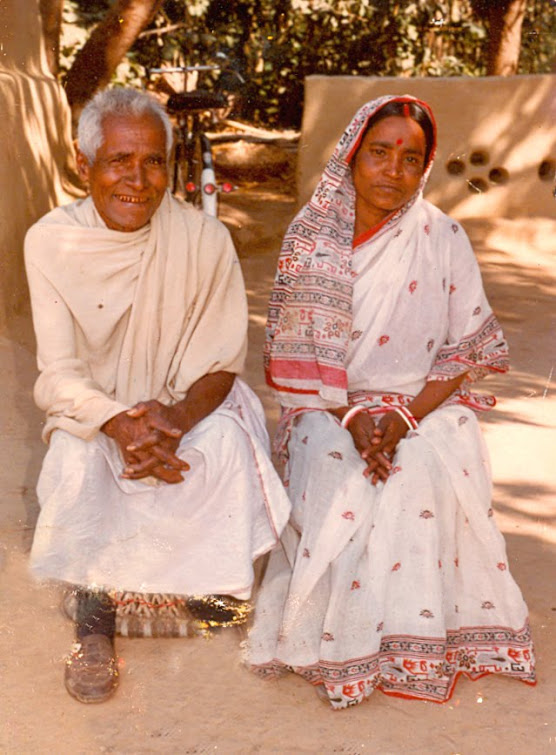
While my Parents Pulin babu and Basanti devi were living


1 comment:
BAMCEF NATIONAL CONVENTION IN NAGPUR
The All India Backward (S.C., S.T., OBC) And Minority Communities Employees Federation, Delhi
Central Office: - 10795, Phoolwali Gali, Manak Pura, Karol Bagh, New Delhi-5. Ph: 011-23614369
Educate ! Organise !! Agitate !!!
BAMCEF
Rashtrapita Jyotirao
Phule
Chhatrapati Shahu jee Periyar E.V. Ramasami Jan Nayak Birsa Munda Dr. Babasaheb Ambedkar
Maharaj
Chhatrapati Shivaji Maharaj Regd. No:. S - 17809
APPEAL
25th National Convention - A Time for Introspection
This year BAMCEF is holding its 25th (Silver Jubilee) National Convention. From the beginning BAMCEF had
dedicated itself to the goal of social change, which our emancipator had laid down. Over the past three decades we had
concentrated specifically on two aspects i.e. first, awakening the society on the issue concerning our condition - thereby
exposing the conspiracy of Brahmanical System and second trying to organize all caste components who are the
sufferers of social system. On both the fronts BAMCEF had succeeded to the extent that the power structure and
Brahminism forces have acknowledged our existence as a pressure group of Phule-Ambedkarite movement. BAMCEF
salutes the dedication, sacrifice and efforts of all its activists who had toiled to achieve this level. With this achievement
one can certainly say that BAMCEF is going ahead in a right manner towards its pre defined objective.
Our impact on the power structure had compelled the Brahmanical forces to redesign their strategies so as to
keep control over the social system. On the other hand BAMCEF had succeeded in motivating various caste components
of Mulnivasi Bahujan Samaj to release themselves from the grip of Brahmanical forces. Such process of action and
counter action is bound to continue in more severe form in the days to come. To cope up with the changing situation we
need to indentify and incorporate stronger inputs to design the strategies to combat Brahminism.
Identity Crisis
While trying to achieve the objective of social change, on one hand we had been exposing the conspiracies of
Brahminical forces to awaken the masses and on the other trying to unite different caste components of 85% Mulnivasi
Bahujan Samaj. Our experience of past three decade revealed that the identity crisis is a major lacuna in keeping the
Mulnivasi Bahujan Samaj united. Hence to forge the homogenous unity amongst different castes we had rejuvenated
Mulnivasi identity. Accepting the common identity can only be the means to march in the direction of achieving the
objective of social change. Having made definite dent of Mulniwasi identity in the society, our enemy has also felt its
impact to the extent that their identity and presence in this country has come under scrutiny.
Strengthening the Movement
It can be seen that in post Ambedkarite era, nobody had laid emphasis on building and strengthening the
movement. All the Phule-Ambedkarite organizations which emerged were mainly out of reactive response. The speed
with which society responded to the reactive issues had also calmed down with equal speed. Such response could not
build the organization and unity in the society. Building the movement with such response will remain only a wishful
thinking. On the other hand movement building process is very slow and the result cannot be seen immediately. Only its
presence and impact can be felt, on power structure which can be observed in the society. Over past three decade
BAMCEF has succeeded in training the human resources, dedicating and committing them towards the objective of
social change and building the movement. BAMCEF had never diverted or diluted this objective. In the light of this
background and on the eve of 25th National Convention, the activists of BAMCEF will be reaffirming its commitment
in further strengthening Phule-Ambedkarite movement. We look forward for awakened response from the society.
Inputs To Achieve the Objective
The objective of social change is not small and simple. It was more difficult during the time our
emancipators, who had led the movement. Their efforts, to the larger extent, had softened the constraints,
which had spoilt the social system. But the challenges which are prevalent today, needs to be dealt with more
determination and dedication. The situation becomes still more challenging because the counter revolutionary
forces in the society are continuously watching our move and re-designing their strategies. The task therefore,
infront of us is two fold : first to strive for achieving the objective of social change and second to understand the
motives and moves of counter revolutionary forces operating in the system.
To handle both the tasks successfully one need to understand and estimate the amount and type of
inputs we have to mobilize to sustain the movement. Trained human resources, financial resources, tapping
human potential spread across the globe, aligning the young generation towards the movement, institutionalizing
the ideology and awakening the masses for the cause all these aspects need to be evaluated not in terms of
changing socio-economic situation and the means to deal with.
25th National convention at Nagpur
Holding the 25th National Convention is a milestone not only for BAMCEF organisation but is so for
Phule-Ambedkarite movement. It indicates the consistency towards our commitment for social change for all
this period. It is in this respect this becomes an historical event for Phule-Ambedkarite movement. On such
occasion our feeling drives us to identify the place of historical importance in the movement. Nagpur has been
the stronghold of Ambedkarite activities. During Babasahebs time Babasaheb himself had given importance to
Nagpur for launching his revolutionary move. Nagpur therefore, is dearer to us when we think of laying this
milestone. We derive inspiration and strength when the idea of hosting the 25th National Convention comes to
our mind. During Babasahebs time Nagpur had witnessed the revolt against Brahminism and the people of
Nagpur had supported Babasaheb wholeheartedly, BAMCEF is also fighting againstBrahminism. Fighting
against Brahminism is a means for social change. The struggle of BAMCEF is for social change. We need to
overthrow Brahminism and bring in social change. Hence we have decided to hold thishistoric event i.e. 25th
National Convention in Nagpur.
In this endeavor we appeal to all the people of Mulnivasi Bahujan Samaj to extend all cooperation with
time, talent and money and participate in this event to register your presence in laying the mile stone.
Date: 24TH September2008
(Satyashodhak Samaj Divas) Yours in Mission
Place: New Delhi
(Dr.L.J.Kanhekar)
National General Secretary
BAMCEF
Post a Comment